
SEO Featured Snippet
How Dopamine Affects Motivation is one of the most important concepts in modern neuroscience. Dopamine is not simply the “feel-good” chemical—it drives anticipation, learning, and goal-directed behavior. Understanding how dopamine works can help you overcome procrastination, improve focus, and build sustainable motivation without relying on constant external rewards.
Introduction
Have you ever wondered why you feel excited to start a new project one day but completely lose interest the next? Why does scrolling through social media feel effortless while starting an important task feels mentally exhausting?
The answer often lies in how dopamine affects motivation. Contrary to popular belief, dopamine isn’t responsible for happiness alone. Instead, it acts as the brain’s motivational messenger, encouraging you to pursue goals, anticipate rewards, and stay engaged in meaningful activities.
Modern neuroscience shows that motivation depends on a delicate balance of dopamine signaling. When this balance is disrupted by chronic stress, digital overstimulation, or unhealthy habits, your ability to focus and stay disciplined begins to decline.
In this guide, you’ll discover why motivation fades, how dopamine shapes your daily behavior, and what science says about restoring healthy motivation naturally.

Why Do I Lose Motivation So Fast?
Losing motivation quickly is one of the most common productivity challenges today. Many people assume they simply lack discipline, but psychology and neuroscience suggest something deeper is happening inside the brain.
Motivation is not a fixed personality trait. It changes according to your brain’s expectations, energy levels, and perceived rewards.
When your brain predicts that a task requires significant effort with little immediate payoff, it naturally resists getting started.
Why Is Starting a Task So Hard?
Beginning a task is often more difficult than completing it.
This happens because your brain constantly weighs effort versus reward before taking action. If the expected reward feels too distant or uncertain, your motivational system produces less enthusiasm.
Several psychological factors increase this mental resistance:
- Fear of failure
- Perfectionism
- Decision fatigue
- Chronic stress
- Mental overload
- Lack of meaningful goals
Together, these factors create what psychologists describe as mental friction—an invisible barrier that makes simple tasks feel overwhelming.
Intrinsic Motivation Deficit
Intrinsic motivation comes from internal satisfaction rather than external rewards.
When your work feels disconnected from your personal values or long-term goals, your brain struggles to generate sustained effort. Even highly capable people experience this intrinsic motivation deficit during periods of burnout or chronic stress.
Without a compelling internal reason to act, procrastination becomes increasingly attractive.
How Reward Anticipation Controls Your First Step
Before you begin any activity, your brain predicts whether the effort will be worthwhile.
This process is called reward anticipation.
If your brain expects a valuable outcome, dopamine activity increases, making it easier to start. If the expected reward seems weak, motivation drops before the task even begins.
This explains why people often spend hours watching videos yet struggle to write a single email or finish an important assignment.
How Constant Scrolling Destroys Motivation
Smartphones have transformed the way our brains experience rewards.
Every notification, short video, or social media like provides a small burst of instant gratification. While each reward feels harmless, repeated exposure gradually changes how your motivational system responds.
The problem isn’t technology itself.
The issue is constant overstimulation.
The Trap of Instant Gratification
Digital platforms are designed to keep users engaged by delivering unpredictable rewards.
Your brain loves novelty.
Every swipe creates anticipation that the next post might be more entertaining than the last.
This continuous reward cycle trains the brain to seek immediate pleasure instead of long-term achievement.
As a result:
- Studying feels boring.
- Exercise seems harder.
- Reading requires more effort.
- Deep work becomes increasingly difficult.
Neurotransmitter Receptor Down Regulation
Repeated exposure to high-frequency digital stimulation can reduce the brain’s sensitivity to dopamine signals over time.
Scientists refer to this adaptation as neurotransmitter receptor down regulation.
Rather than producing more motivation, excessive stimulation makes normal daily activities feel less rewarding.
You may notice:
- Constant boredom
- Difficulty concentrating
- Reduced excitement for hobbies
- Increased dependence on entertainment
- Chronic procrastination
Although the brain remains remarkably adaptable, prolonged overstimulation can temporarily reduce your ability to enjoy slower, meaningful activities.
From Healthy Goal Pursuit to Short-Term Reward Loops
Healthy motivation encourages people to pursue education, relationships, fitness, creativity, and personal growth.
However, instant digital rewards shift attention toward activities requiring minimal effort but delivering immediate pleasure.
This creates a behavioral loop:
- Feel slightly bored.
- Open social media.
- Receive quick entertainment.
- Temporary relief.
- Return to work feeling even less motivated.
Over time, this cycle weakens persistence and makes long-term goals feel emotionally distant.
Breaking this loop requires retraining the brain to appreciate delayed rewards rather than constant stimulation.

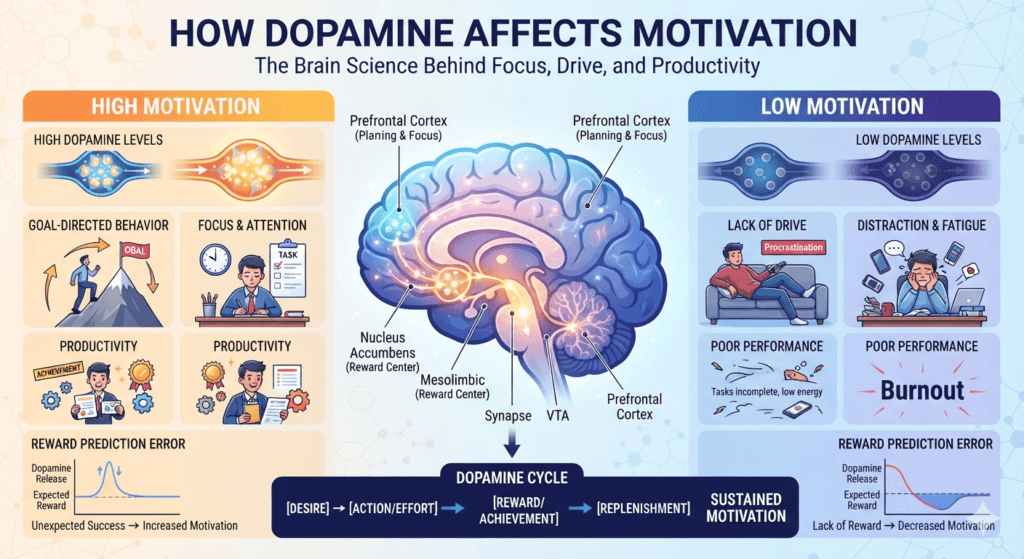
The Science of Drive: How Dopamine Affects Motivation
To understand lasting motivation, it’s important to understand how the brain generates the desire to pursue goals.
Dopamine is one of the central neurotransmitters involved in learning, movement, curiosity, and decision-making.
Rather than creating pleasure directly, dopamine increases your willingness to invest effort toward a future reward.
This is why neuroscientists often describe dopamine as the brain’s “wanting” chemical rather than the “liking” chemical.
Mesolimbic Pathway Activation: The Brain’s Motivation Engine
One of the most important systems involved in how dopamine affects motivation is the mesolimbic pathway.
This network connects several brain regions responsible for reward, learning, and emotional reinforcement.
Whenever your brain detects an opportunity worth pursuing—whether earning a promotion, solving a puzzle, or achieving a fitness goal—the mesolimbic pathway becomes active and releases dopamine.
The stronger the expected reward, the stronger the motivational signal.
The Striatum and Goal-Directed Behavior
The striatum acts like the brain’s action center.
It helps convert motivation into behavior by selecting and reinforcing actions that move you closer to a desired outcome.
Every habit you build—from exercising regularly to checking your phone—is influenced by this region.
When dopamine signaling functions well, the striatum supports:
- Consistent habits
- Better decision-making
- Goal persistence
- Increased willingness to work
When dopamine signaling declines, maintaining these behaviors becomes much more difficult.
The Prefrontal Cortex: Your Executive Control Center
The prefrontal cortex is responsible for executive function, including planning, organizing, impulse control, and problem-solving.
This area helps you resist distractions and stay focused on long-term objectives.
Healthy dopamine activity allows the prefrontal cortex to:
- Prioritize important tasks
- Resist instant gratification
- Manage complex projects
- Maintain concentration
- Make thoughtful decisions
When dopamine regulation is disrupted by stress, poor sleep, or excessive digital stimulation, executive function often suffers—making productivity feel like an uphill battle.
Tonic Versus Phasic Release: Explaining Your Daily Energy
Not all dopamine is released in the same way. Neuroscientists generally describe dopamine activity in two patterns: tonic release and phasic release. Understanding these patterns explains why some days you feel consistently productive while other days you experience only short bursts of motivation.
What Is Tonic Dopamine Release?
Tonic dopamine refers to the steady, background level of dopamine circulating in your brain. Think of it as your brain’s “baseline fuel.”
A healthy tonic dopamine level supports:
- Stable energy throughout the day
- Emotional resilience
- Consistent motivation
- Better concentration
- Improved stress management
When tonic dopamine is too low, everyday activities can feel unusually difficult. You may wake up feeling mentally tired even after adequate sleep or struggle to find enthusiasm for tasks you once enjoyed.
Signs of Low Tonic Dopamine
Low tonic dopamine may contribute to:
- Reduced mental energy
- Lack of initiative
- Difficulty maintaining routines
- Persistent procrastination
- Feeling emotionally “flat”
While these symptoms can have many causes, chronic stress, poor sleep, and unhealthy lifestyle habits commonly affect dopamine regulation.
What Is Phasic Dopamine Release?
Unlike tonic release, phasic dopamine consists of brief spikes triggered by something important or unexpected.
Examples include:
- Receiving praise at work
- Completing a difficult project
- Winning a competition
- Learning exciting news
- Reaching a personal milestone
These temporary increases create a feeling of excitement that encourages your brain to repeat rewarding behaviors.
However, relying only on phasic dopamine can become problematic if you’re constantly chasing quick excitement instead of building sustainable habits.
How These Two Systems Shape Your Focus
Think of motivation like driving a car.
- Tonic dopamine is the fuel in the tank.
- Phasic dopamine is the burst of acceleration when you press the gas pedal.
You need both systems working together.
Strong baseline dopamine helps you stay productive throughout the day, while healthy phasic spikes make achievements feel rewarding enough to repeat.
The Reward Prediction Error Model: Why Rewards Stop Motivating You
Have you ever bought something you’ve always wanted, only to lose excitement after a few weeks?
This phenomenon is explained by the reward prediction error model, one of the most influential theories in behavioral neuroscience.
Understanding Reward Prediction Error
Your brain constantly compares:
- What reward you expected
- What reward you actually received
If reality exceeds expectations, dopamine activity temporarily increases.
If the reward matches expectations exactly, the dopamine response gradually decreases.
If the reward falls short, dopamine activity may even decline.
This learning process helps your brain decide which behaviors are worth repeating.
Why Repetition Reduces Excitement
The first time you experience something new, your brain releases a strong dopamine signal because of novelty.
As the experience becomes predictable, the response weakens.
This explains why:
- A new phone becomes ordinary.
- Your favorite game becomes less exciting.
- A promotion eventually feels normal.
- Even enjoyable routines lose their emotional impact.
This isn’t a flaw in your brain—it’s an adaptation that encourages continuous learning and growth.
Keeping Motivation Alive
Instead of depending solely on external rewards, successful people introduce:
- New challenges
- Progressive goals
- Skill development
- Creative variation
- Meaningful personal milestones
These strategies help maintain healthy dopamine responses over time.

Identifying and Fixing Deep Brain Burnout
Many people describe themselves as “lazy” when they’re actually experiencing mental exhaustion.
Brain burnout develops gradually after prolonged stress, emotional overload, poor recovery, and constant overstimulation.
Instead of generating motivation, the brain shifts into an energy-conservation mode.
Understanding this difference is the first step toward recovery.
Signs of Low Dopamine Burnout
Although dopamine is only one part of a complex neurological system, long-term dysregulation can contribute to symptoms commonly associated with burnout.
Common warning signs include:
- Persistent brain fog
- Lack of enthusiasm
- Emotional numbness
- Chronic fatigue
- Difficulty making decisions
- Reduced curiosity
- Loss of interest in hobbies
- Poor concentration
- Low productivity
- Increased procrastination
These symptoms often overlap with stress, anxiety, depression, sleep disorders, or other medical conditions. Persistent symptoms should be evaluated by a qualified healthcare professional.
Brain Fog and Apathy
Brain fog makes thinking feel slow and mentally exhausting.
Simple decisions suddenly require extra effort, while tasks that once felt manageable now seem overwhelming.
At the same time, apathy reduces emotional engagement.
You may know what needs to be done but struggle to care enough to begin.
The Reality of Dopamine Baseline Levels
Your brain maintains a natural dopamine baseline that influences everyday motivation.
Healthy habits help support this baseline, while chronic stress may gradually lower it.
How Chronic Stress Changes Motivation
Long-term stress activates cortisol, the body’s primary stress hormone.
Persistently elevated cortisol can interfere with several brain systems involved in attention, learning, and motivation.
Over time, you may notice:
- Less excitement
- Reduced concentration
- Increased fatigue
- Slower recovery after work
- Lower resilience
The combination creates a cycle where stress reduces motivation, and reduced motivation creates even more stress.
Delayed Gratification Becomes Harder
People with lower motivational energy often struggle to wait for long-term rewards.
Instead of investing effort today for future success, the brain naturally seeks immediate comfort.
Examples include:
- Watching another episode instead of studying
- Checking social media during work
- Buying unnecessary items for instant satisfaction
- Skipping exercise because results feel distant
Building delayed gratification requires gradually strengthening your ability to tolerate short-term discomfort in exchange for meaningful long-term benefits.
The Relationship Between Dopamine and ADHD Motivation
One of the most researched areas in neuroscience is the relationship between dopamine signaling and Attention-Deficit/Hyperactivity Disorder (ADHD).
Researchers believe differences in dopamine pathways may contribute to some ADHD symptoms, although the condition is complex and involves multiple brain networks.
Executive Dysfunction
Many individuals with ADHD experience executive dysfunction, including difficulty with:
- Starting tasks
- Organizing priorities
- Managing time
- Maintaining attention
- Finishing projects
Importantly, this is not simply a lack of willpower. It reflects differences in how the brain regulates attention and motivation.
Hyperfocus and Motivation
A fascinating characteristic of ADHD is hyperfocus.
When an activity is highly stimulating or personally interesting, dopamine signaling may support intense concentration for extended periods.
However, routine or repetitive tasks often fail to produce the same level of engagement, making them much harder to begin or sustain.
Behavioral Neuroscience and Addiction
Behavioral neuroscience also shows that highly rewarding activities—such as gaming, gambling, or endlessly scrolling social media—can strongly engage dopamine pathways.
For some individuals, especially those already vulnerable to attention or impulse-control difficulties, these activities may become difficult to regulate.
Recognizing these patterns is essential for building healthier habits and reducing dependence on constant stimulation.
Actionable Strategies to Reset and Reclaim Focus
Understanding how dopamine affects motivation is only the first step. The next step is applying evidence-based habits that help your brain regain balance. While there is no instant “dopamine reset,” consistent lifestyle changes can improve motivation, focus, and long-term productivity through the brain’s natural ability to adapt.
Can You Reset Your Dopamine Receptors?
The phrase “dopamine receptor reset” has become popular online, but it is often misunderstood. You cannot simply reset your brain overnight. However, your brain constantly changes through neuroplasticity, meaning healthy habits can strengthen neural pathways and improve motivation over time.
The Truth About Receptor Recovery
Excessive stimulation from social media, gaming, junk food, or constant multitasking may reduce your sensitivity to everyday rewards. Fortunately, reducing overstimulation allows your brain to gradually respond better to natural sources of satisfaction.
Recovery depends on:
- Consistent sleep
- Regular physical activity
- Balanced nutrition
- Reduced screen time
- Stress management
- Meaningful daily goals
Small improvements practiced consistently are far more effective than extreme “dopamine detox” challenges.
Neuroplasticity and Habit Formation
Neuroplasticity refers to the brain’s ability to reorganize itself by creating new neural connections.
Every time you repeat a healthy habit—whether exercising, reading, meditating, or completing focused work—you strengthen the neural circuits that support motivation and discipline.
This is why consistency always beats intensity.
How Dopamine Fasting Affects Focus
Dopamine fasting does not eliminate dopamine. Instead, it involves temporarily reducing unnecessary stimulation so your attention can shift back toward meaningful activities.
The goal is to decrease constant distractions—not avoid pleasure altogether.
A Practical Digital Detox Framework
Try these simple steps:
1. Schedule Screen-Free Time
Set aside one or two hours each day without social media, gaming, or unnecessary notifications.
2. Remove Constant Notifications
Disable non-essential alerts that interrupt deep concentration.
3. Replace Digital Rewards
Instead of endless scrolling, choose activities like:
- Walking outdoors
- Reading
- Journaling
- Exercise
- Creative hobbies
4. Practice Mindful Boredom
Allow yourself short periods without entertainment. Boredom encourages creativity and helps your brain appreciate slower, meaningful rewards again.
After several weeks, many people notice improved concentration, greater patience, and better emotional balance.

How to Increase Dopamine for Motivation Naturally
Healthy dopamine regulation depends on daily habits rather than quick fixes. Sustainable improvements come from supporting overall brain health.
How to Trick Your Brain Into Working
Large projects often trigger overwhelm. Instead of waiting to “feel motivated,” create momentum through small wins.
Micro-Tasking
Break large goals into tiny actions.
Instead of:
Write a report.
Start with:
Open the document.
Completing one small task creates a minor dopamine reward, making the next step feel easier.
The Five-Minute Rule
Promise yourself you’ll work for only five minutes.
Once you’ve started, psychological resistance usually decreases, making it easier to continue.
Celebrate Small Wins
Each completed step reinforces productive behavior.
Examples include:
- Checking off a to-do list
- Completing one workout
- Finishing one paragraph
- Cleaning one room
Small victories gradually build lasting discipline.
Natural Ways to Boost Dopamine Levels
Your lifestyle has a powerful influence on your brain’s motivational system.
Prioritize Quality Sleep
Sleep restores brain function and supports healthy neurotransmitter activity.
Aim for:
- 7–9 hours of consistent sleep
- Regular bedtime
- Limited screen exposure before bed
Exercise Regularly
Physical activity supports brain health while improving mood and motivation.
Excellent choices include:
- Walking
- Resistance training
- Cycling
- Swimming
- Yoga
Even a 20-minute walk can improve mental clarity.
Cold Exposure
Some research suggests brief cold exposure may temporarily increase alertness and influence neurotransmitter activity.
Examples include:
- Cool showers
- Cold-water face washing
- Outdoor walks during cooler weather
Always use caution and avoid extreme cold exposure, especially if you have medical conditions.
Eat Foods That Support Dopamine Production
Dopamine is produced from the amino acid tyrosine.
Tyrosine-rich foods include:
- Eggs
- Fish
- Chicken
- Turkey
- Greek yogurt
- Soy products
- Almonds
- Pumpkin seeds
- Avocados
- Beans
A balanced diet also supports overall neurotransmitter synthesis and brain function.
Best Supplements for Dopamine and Drive
Supplements should support—not replace—a healthy lifestyle.
Current evidence suggests these may be beneficial for some individuals:
L-Tyrosine
An amino acid involved in dopamine production.
It may help during periods of acute stress or mental fatigue but should not be viewed as a daily motivation booster for everyone.
Mucuna Pruriens
A natural plant containing L-DOPA, a dopamine precursor.
Because it directly affects dopamine pathways, it should be used cautiously and preferably under medical supervision.
Omega-3 Fatty Acids
Omega-3s support brain health and may contribute to healthy cognitive function.
They are among the most widely researched supplements for overall neurological wellness.
Important: Always consult a qualified healthcare professional before starting supplements, especially if you have medical conditions, take prescription medications, or are pregnant or breastfeeding.
How to Build Discipline With Low Dopamine
Motivation naturally rises and falls. Discipline keeps you moving forward even when motivation is low.
Instead of waiting to “feel ready,” build systems that make productive actions automatic.
Dopamine Optimization Framework
The table below summarizes practical strategies that support healthier motivation.
| Strategy | Neurological Impact | Target User Pain Point |
|---|---|---|
| Micro-Tasking | Creates small phasic dopamine responses through quick wins | Task paralysis and overwhelm |
| Digital Detox | Reduces overstimulation and supports healthier reward sensitivity | Brain fog and excessive screen use |
| Delaying Rewards | Strengthens tolerance for delayed gratification | Chronic procrastination |
| Regular Exercise | Supports overall brain function and motivation | Low daily energy |
| Quality Sleep | Helps regulate neurotransmitter activity | Mental fatigue |
| Meaningful Goal Setting | Improves intrinsic motivation | Lack of purpose |
The most successful people don’t depend on constant inspiration—they build routines that make progress easier every day.
Conclusion: Mastering Your Neurochemistry for Lasting Success
Understanding how dopamine affects motivation changes the way we think about productivity. Motivation isn’t simply a matter of willpower; it’s influenced by complex brain systems that respond to rewards, habits, stress, and environment.
While dopamine plays a vital role in goal-directed behavior, lasting success comes from combining healthy lifestyle habits with structured discipline. Improving sleep, exercising regularly, limiting digital distractions, and celebrating small achievements can gradually strengthen your brain’s natural motivational systems.
Instead of searching for a quick fix, choose one positive change today. Small, consistent actions repeated over time have the greatest power to reshape your habits, improve focus, and build lasting motivation.
Frequently Asked Questions (FAQs)
Dopamine primarily supports motivation, learning, and reward anticipation rather than directly creating happiness. It encourages you to pursue goals, while other brain chemicals also contribute to feelings of pleasure and well-being.
Excessive dopamine activity or overstimulation from constant rewards can disrupt healthy motivation patterns. Balance is more important than simply having higher dopamine levels.
The idea of completely “fasting” from dopamine is a misconception because your brain continuously produces dopamine. However, reducing unnecessary digital stimulation can help improve focus and reduce distractions for many people.
There is no fixed timeline. Many people notice gradual improvements over several weeks of consistent healthy habits such as better sleep, regular exercise, reduced screen time, and structured routines. Long-term consistency produces the most sustainable results.

“Hi, I am Umer Hasib. I am a passionate blogger and content creator who loves exploring human psychology, social behaviors, and personal growth. Welcome to my inner space!”
“Excellent deep dive into the neuroscience of drive. I really appreciate how you connected technical terms like the mesolimbic pathway to practical solutions like micro-tasking. The framework table comparing strategies against neurological impacts makes the science so easy to apply. I’m definitely going to try tweaking my dopamine baseline levels using the natural protocols mentioned here!”
“Love this, thank you! It’s awesome to hear that the framework table made the science easy to apply. Task paralysis is so real, but shifting those baseline levels naturally makes a world of difference. Keep us posted on your progress, and definitely let me know if micro-tasking helps you crush your goals this week!”
“This breakdown of the reward prediction error model is a massive eye-opener. I always assumed my sudden drops in motivation were just a lack of willpower, but understanding that it’s a neurological pattern completely changes my perspective. The section on how constant scrolling causes receptor down-regulation hit hard—it explains exactly why starting actual work feels so painful afterward. Thanks for sharing these actionable strategies!”
“Spot on! Shifting from guilt to understanding your neurochemistry is a total game-changer. That scrolling trap is tough, but now that you know about receptor down-regulation, you can actively outsmart it. Try a 10-minute digital-free buffer before your next deep work session. You’ve got the tools now—good luck!”