
Featured Snippet:
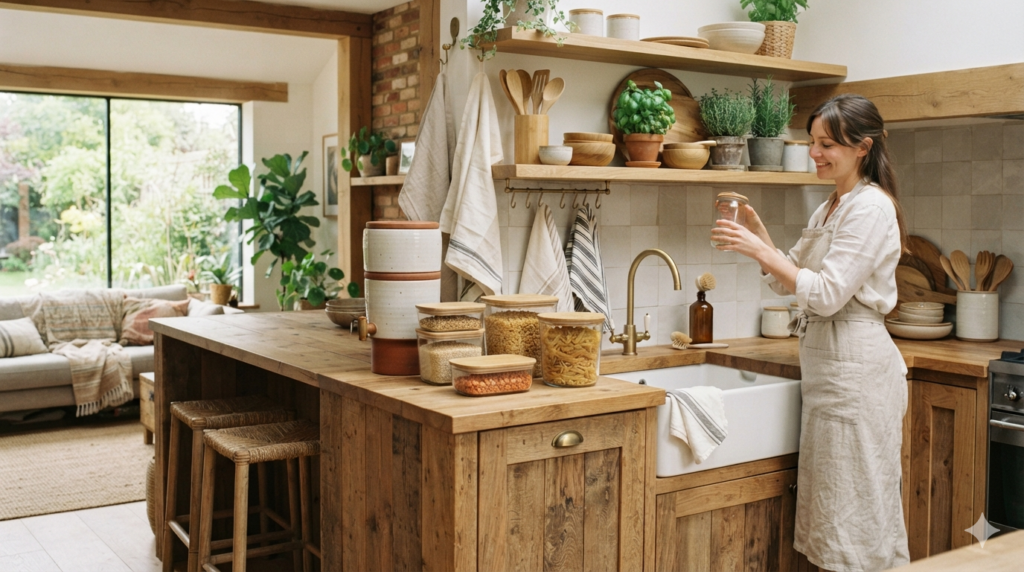
If you want to buy eco friendly home goods without overspending, focus on durable materials, refillable products, verified certifications, secondhand finds, and cost-per-use savings. Start with high-waste household items such as towels, cleaners, storage, and bedding, then replace products gradually instead of throwing away usable items.
Introduction
Sustainable living often sounds expensive. Organic cotton sheets, reclaimed-wood furniture, refill systems, glass storage, and certified cleaning products can carry higher upfront prices than conventional alternatives. That sticker shock is real.
But sustainable shopping does not mean buying the most expensive product with a green label.
A smarter approach is to consider durability, reuse, repairability, certifications, material quality, and cost per use. In many cases, paying more once can make financial sense when the product replaces dozens of disposable purchases over several years.
The goal is not to create a perfectly sustainable home overnight. It is to make better purchasing decisions, one category at a time.
Where to Buy Affordable Eco Friendly Home Goods Without Overpaying
The easiest way to buy eco friendly home goods on a budget is to stop treating sustainability as a luxury category.
Instead, compare products according to their entire useful life.
For example, a reusable glass bottle may cost more than a disposable plastic bottle, but it can be used repeatedly. Similarly, concentrated cleaning tablets can replace numerous single-use spray bottles.
Before buying, ask:
- Will I use this product frequently?
- Can it be reused or refilled?
- Is it durable enough to last?
- Is there a credible certification?
- Can I buy it secondhand?
- Does the manufacturer explain its materials and production?
- What is the cost per use?
Also remember that the most sustainable product is often the product you already own. Throwing away a functional item simply because a greener alternative exists creates unnecessary waste.
How to Build an Eco Friendly Bedroom Setup on a Budget
If you’re wondering how to build an eco friendly bedroom setup on budget, start with the items that have the most direct and frequent use.
You do not need to replace your entire bedroom at once.
Begin with bedding. Look for durable cotton or linen, and when organic cotton is important to you, check whether the finished textile carries a credible certification rather than relying solely on words such as “natural” or “eco.”
For organic textiles, GOTS — Global Organic Textile Standard is particularly useful because its current Version 8.0 covers organic-fiber requirements, processing, environmental criteria, social responsibility, supply-chain accountability, and labeling.
For textile safety, OEKO-TEX STANDARD 100 is another useful reference. It tests textile products for harmful substances, with requirements becoming stricter for products that have more direct skin contact.
For decor, combine affordable foundation pieces with upcycled home accessories and decor.
Try:
- A secondhand wooden bedside table
- A thrifted mirror
- Vintage baskets
- Repurposed glass jars
- Secondhand lamps
- DIY shelves made from reclaimed timber
- Fabric storage baskets
- Existing furniture refreshed with a suitable finish
You can even turn an old wooden crate into a bedside table. The result can look more distinctive than a matching bedroom set while keeping a usable item out of the waste stream.
The key is to buy fewer things and make each purchase work harder.
Is Buying Eco Friendly Home Products Actually Better for Your Budget?
The answer to is buying eco friendly home products actually better for budget depends on the product.
A reusable product is not automatically cheaper. The financial benefit becomes clearer when you calculate cost per use.
For example:
Cost per use = purchase price ÷ estimated number of uses
A $20 reusable item used 200 times costs approximately $0.10 per use before considering maintenance. A $5 disposable product used once costs $5 per use.
This is why refillable systems can be particularly interesting.
A concentrated cleaner, for instance, may require a reusable bottle plus refill tablets or concentrate. Instead of repeatedly purchasing a new plastic spray bottle, you purchase the active cleaning product and reuse the container.
For cleaning products, the EPA Safer Choice program provides a useful verification tool. EPA says Safer Choice helps consumers identify products that perform while using ingredients considered safer for human health and the environment.
The important lesson: compare lifetime cost, not just shelf price.
Financial Breakdown: Initial Cost vs. Potential 3-Year Savings
The following figures are illustrative estimates rather than universal market prices. Actual savings vary according to local prices, frequency of use, product quality, and household size.
| Household Item Category | Conventional Option | Sustainable Swap | Example Initial Cost | Potential 3-Year Savings* |
|---|---|---|---|---|
| Kitchen Towels & Storage | Paper towels & plastic wrap | Reusable cotton towels & reusable wrap | $25 | $180 |
| Surface Cleaner | Disposable plastic spray bottles | Reusable bottle + concentrated refills | $15 | $110 |
| Laundry Care | Conventional detergent jugs | Concentrated sheets/refills | $22 | $75 |
| Bath Accessories | Synthetic disposable-style accessories | Durable natural-fiber alternatives | $12 | $35 |
*Illustrative planning figures supplied for comparison, not guaranteed savings.
The biggest takeaway is not the exact dollar amount. It is the replacement frequency. Products that are repeatedly thrown away offer more opportunities for savings when replaced with durable or refillable alternatives.
How to Tell If Eco Friendly Home Goods Are Genuine
The sustainability market has a credibility problem: almost anything can be described as “green,” “earth-friendly,” or “natural.”
That does not automatically make the product environmentally superior.
The U.S. Federal Trade Commission’s Green Guides emphasize that environmental marketing claims should be truthful and supported by competent and reliable evidence.
So, how to tell if eco friendly home goods are genuine?
Look beyond the front of the package.
Navigating Greenwashing and Third-Party Eco-Certifications
A stronger buying process is:
- Identify the specific environmental claim.
- Check the material composition.
- Look for a recognized certification where relevant.
- Check whether the certification applies to the actual product.
- Look for a certificate, license, or verification number when available.
- Read the manufacturer’s sustainability information.
- Be skeptical of vague claims without supporting evidence.
For organic textiles, GOTS is especially relevant because its current standard requires correct certification and labeling before retailers can make GOTS claims about finished products.
OEKO-TEX STANDARD 100 serves a different purpose: it focuses on testing textiles for harmful substances rather than proving that a product is organic.
For companies, B Corp certification can provide another signal, although it evaluates the business’s broader social, environmental, and governance performance, not whether every individual product is environmentally superior. B Lab’s updated standards are being applied to companies certifying under its newer 2026 framework, with independent third-party verification.
In other words, one certification should never be treated as proof of everything.
What Materials Should You Avoid When Buying Sustainable Decor?
When choosing sustainable decor, don’t focus only on whether something looks natural.
Consider materials and finishes too.
Potential concerns include:
- High-emitting finishes
- Certain phthalates
- Formaldehyde-containing composite wood products
- Excessive synthetic microfiber shedding
- Strong solvent-based finishes
- High-VOC paints and coatings
VOCs are chemicals released as gases from certain solids and liquids. The EPA notes that paints, varnishes, waxes, cleaning products, and numerous other household products can release VOCs, and indoor concentrations of many VOCs can be higher than outdoor concentrations.
However, don’t assume that a “low-VOC” label automatically means a product is completely risk-free. EPA specifically warns that VOC labeling can be confusing because some toxic chemicals may not fall under VOC definitions used in outdoor-air regulations.
For paint and furniture, prioritize transparent ingredient information, appropriate certifications, adequate ventilation, and products designed for indoor use.
What Are the Best Zero Waste Home Products for Kitchen & Cleaning?
The kitchen is one of the easiest places to make meaningful sustainable swaps because it contains many frequently used disposable products.
The best zero waste home products are usually simple:
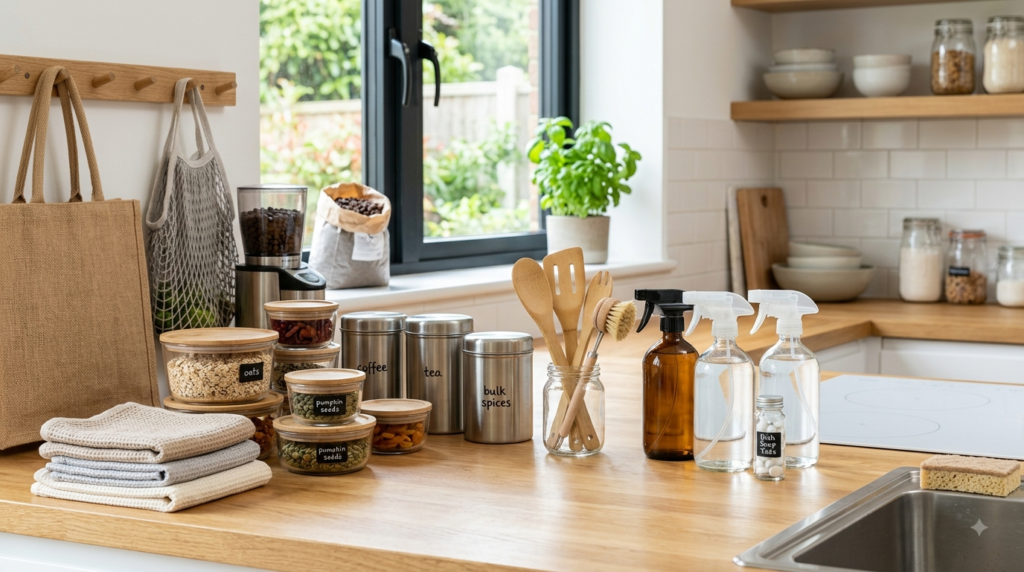
- Glass food containers
- Stainless-steel storage
- Reusable food bags
- Cloth kitchen towels
- Durable wooden utensils
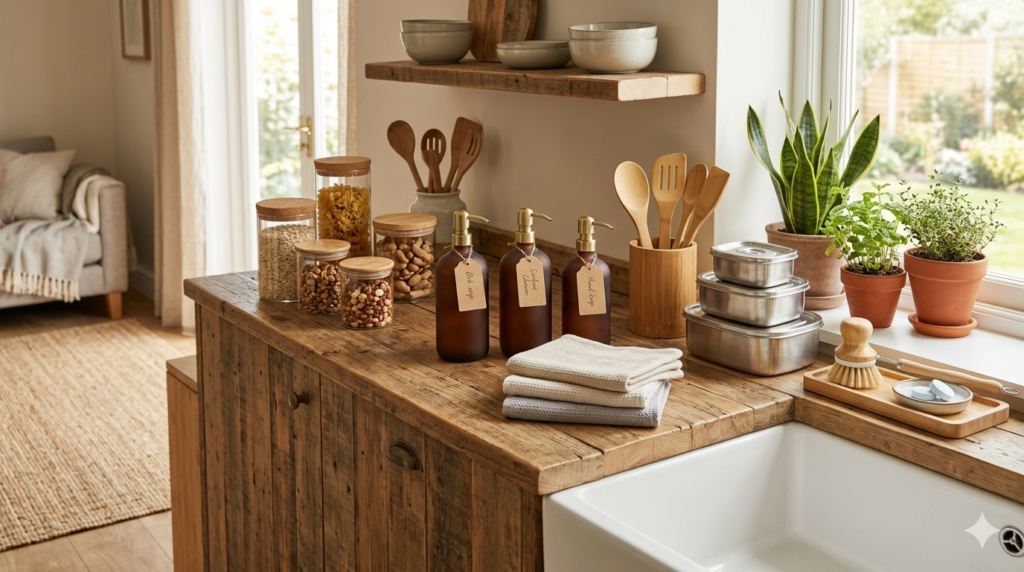
- Refillable soap dispensers
- Reusable produce bags
- Compostable or reusable alternatives where appropriate
- Concentrated cleaning products
- Refillable cleaning systems
Essential Plastic Free Kitchen Storage Solutions & Essentials
If you’re asking where can I buy plastic free kitchen products online, look for retailers that clearly disclose materials, manufacturing information, and replacement/refill options.
Glass and stainless steel are popular choices for food storage because they are durable and easy to reuse.
But don’t replace every plastic container in your kitchen simply because it is plastic.
If a plastic container is safe, functional, and already owned, continuing to use it may be more resource-efficient than immediately throwing it away.
A practical replacement hierarchy is:
Use → Maintain → Repair → Reuse → Replace when necessary → Recycle/dispose responsibly
That approach avoids creating waste in the name of reducing waste.
Are Non-Toxic Kitchen Essentials Worth the Money?
Are non toxic kitchen essentials worth the money? Sometimes—but the answer depends on construction, durability, and actual use.
For cookware, stainless steel and cast iron can be durable alternatives to repeatedly replacing lower-quality cookware.
For cutting boards, hardwood can provide a long-lasting option when properly maintained.
For every product, consider:
- Expected lifespan
- Maintenance requirements
- Repairability
- Food-contact suitability
- Manufacturer transparency
- Warranty
- End-of-life options
Don’t pay extra simply because a product uses the word “non-toxic.” Look for meaningful product information instead.
Bulk Buying Biodegradable Cleaning Supplies & Refill Systems
Biodegradable cleaning supplies bulk buy options can reduce packaging waste when the product genuinely meets your needs and can be stored safely.
Refillable eco friendly cleaning products can also make financial sense because one reusable container can be paired with multiple refills.
Before subscribing to a refill service, calculate:
Price per refill + shipping ÷ expected uses
A subscription is not automatically cheaper or greener. If you receive more product than you can use, the system may work against your actual needs.

What Is the Safest Non-Toxic Furniture & Decor for Healthy Homes?
When shopping for furniture, durability and material transparency matter just as much as appearance.
Solid wood, responsibly sourced timber, well-maintained secondhand furniture, and properly finished reclaimed wood can all be useful choices.
Finding Low-VOC Eco Interior Paint & Reclaimed Wood Furniture
If you’re asking what is the safest non toxic furniture for homes, start by examining construction.
Solid wood furniture can avoid some of the composite-material issues associated with particleboard and fiberboard, although finishes, adhesives, and treatments still matter.
Reclaimed wood can also be an excellent sustainability choice because it gives existing material another useful life.
For paint, look for appropriate low-emission products and follow manufacturer instructions for ventilation and curing. Remember that “low VOC” is not an all-purpose guarantee of safety. EPA’s indoor-air guidance specifically explains why VOC labels should be interpreted carefully.
For buyers in the United States, also consider environmental and indoor-air certifications relevant to the particular product rather than relying on generic marketing.
Where to Find Fair Trade Artisan Home Accessories Online
If you’re wondering where to find fair trade artisan home accessories online, look for organizations and marketplaces that explain how products are sourced and how producers are compensated.
Fair-trade purchasing can connect environmental goals with social considerations such as producer livelihoods, working conditions, and community development.
For rugs, baskets, ceramics, woven goods, and decorative pieces, ask:
- Who made the product?
- Where was it made?
- Is the producer identified?
- Is there a recognized fair-trade certification?
- What materials were used?
- Is the item designed for long-term use?
Handmade does not automatically mean sustainable, so transparency still matters.
Sustainable Home Decor Brands List That Ship Internationally
There is no universal list of brands that will always provide carbon-neutral international shipping because shipping policies, destinations, packaging programs, and environmental claims can change.
Instead of promising that every international brand is carbon-neutral, check the retailer’s current shipping policy before ordering.
For international shoppers, compare:
- Product material
- Manufacturing location
- Packaging
- Shipping distance
- Return policy
- Durability
- Repair/replacement options
- Environmental certifications
Sometimes buying a high-quality product manufactured closer to your home can make more sense than importing a supposedly greener item from the other side of the world.
That is a crucial part of learning to buy eco friendly home goods intelligently.
What Are the Most Durable Eco Friendly Bath & Bed Products?
Textiles can be sustainable purchases when they are durable, washable, and used for years.
Instead of chasing the newest “eco” collection, focus on quality and longevity.
Evaluating Compostable Bamboo Bath Linens & Organic Towels
When comparing bamboo textiles with GOTS certified organic cotton towels, look at the complete product rather than the raw material alone.
Compare:
| Feature | Organic Cotton | Bamboo-Based Textile |
| Softness | Generally soft, depending on weave | Often very soft |
| Absorbency | Typically strong | Often highly absorbent |
| Durability | Good with quality construction | Depends heavily on fiber processing |
| Certification | GOTS may verify organic textile supply chain | Certification depends on actual product |
| End of life | Depends on dyes, blends and finishes | Depends on fiber type and processing |
| Best buying signal | Verified certification + construction | Transparent fiber/process information |
The phrase compostable bamboo bath linens review should therefore be approached carefully. “Bamboo” does not automatically mean that a finished textile is compostable. Fiber processing, dyes, blends, stitching, and finishing can all affect end-of-life options.
Investing in Non-Toxic Organic Bed Sheets for Better Sleep
For non toxic organic bed sheets, focus on fabric quality, breathability, construction, and verified certifications.
Cotton and linen can both be comfortable choices, while organic certification can provide additional information about how the fiber was produced and processed.
For products that touch your skin for many hours, OEKO-TEX STANDARD 100 can be another useful certification to investigate because its testing considers harmful substances and uses stricter requirements for textiles with more direct skin contact.
The goal isn’t to create a chemically perfect bedroom. It is to choose transparent, durable products and avoid unnecessary replacement.
How to Replace Household Plastic with Eco Friendly Alternatives Step-by-Step
A full-home sustainability makeover can become overwhelming quickly.
Instead, use a simple sequence.
Step 1: Audit Your Daily Single-Use Household Waste
For seven days, record the disposable products your household throws away.
Look for repeated items such as:
- Plastic water bottles
- Cling film
- Disposable food bags
- Plastic soap bottles
- Paper towels
- Single-use cleaning containers
- Disposable kitchen accessories
Then identify the top three waste-producing products.
Don’t try to replace everything simultaneously.
Step 2: Transition Kitchen and Bath Essentials
Use the replacement rule:
Replace items when they run out, break, or become unusable.
For example, when your dish soap bottle is empty, investigate a refill system.
When plastic food storage finally breaks, consider glass or stainless steel.
When towels become unusable, choose durable natural-fiber replacements.
This approach is cheaper than throwing away functional products and purchasing an entirely new “zero waste” collection.
For kitchen storage, prioritize plastic free kitchen storage solutions that fit your actual lifestyle rather than products that simply look sustainable on social media.
Step 3: Upgrade to Energy-Efficient Smart Home Gadgets
Sustainability is not only about physical products.
Energy use matters too.
Consider:
- LED lighting
- Programmable schedules
- Smart plugs for appropriate devices
- Energy monitoring
- Efficient appliances
- Smart thermostats where compatible with your HVAC system
ENERGY STAR explains that certified smart thermostats are independently evaluated using real-world data and can automatically adjust heating and cooling schedules.
A smart gadget is worthwhile when it actually reduces unnecessary energy use—not simply because it connects to an app.
Conclusion: Making Sustainable Living Simple and Accessible
Learning to buy eco friendly home goods does not require a huge budget or a perfectly sustainable lifestyle.
The smartest strategy is gradual.
Start with products you purchase repeatedly. Choose durable items over disposable ones. Use refill systems where they genuinely reduce packaging and cost. Buy secondhand furniture and decor when practical. Check certifications rather than trusting vague green claims. And remember that keeping a useful product in service is often better than replacing it prematurely.
Most importantly, calculate cost per use, not just purchase price.
A $30 product used hundreds of times may be a better financial decision than repeatedly buying $5 disposable alternatives. Likewise, an inexpensive “eco” product that breaks quickly may create more waste and expense than a well-made conventional product that lasts for years.
Start with one room—perhaps your kitchen or bathroom.
Make two or three thoughtful swaps, track the results, and build from there.
Sustainable living works best when it becomes a normal purchasing habit rather than an expensive race toward perfection.
Frequently Asked Questions
Yes. Start with secondhand furniture, reusable products, energy-efficient lighting, refill systems, and items that replace frequently purchased disposables. You do not need to replace your whole home at once.
No. Price alone does not prove sustainability. Check durability, materials, certifications, manufacturing information, repairability, packaging, and expected lifespan before deciding.
Start with products you use frequently and replace often, such as cleaning supplies, paper towels, food-storage products, and basic textiles. These categories offer repeated opportunities to reduce waste and potentially lower long-term spending.
Look for specific, verifiable claims instead of vague words such as “green” or “earth-friendly.” Check recognized certifications, product materials, company disclosures, and whether the certification actually applies to the product you are buying. The FTC’s Green Guides are a useful reference for understanding environmental marketing claims.

“Hi, I am Umer Hasib. I am a passionate blogger and content creator who loves exploring human psychology, social behaviors, and personal growth. Welcome to my inner space!”
Name: Maya Lin
Such a well-researched guide! The cost-per-use breakdown for refillable cleaning products vs. single-use plastic really made things click for me—I think many people assume sustainable living is always more expensive upfront, but looking at long-term savings makes a huge difference. I’ve already made the switch to organic cotton kitchen towels, and I’m definitely checking out the zero-waste storage brands you recommended next. Thanks for putting together such a clear, practical roadmap!
Hi Maya, thank you so much for the kind words! You hit the nail on the head—shifting the mindset to long-term value and cost-per-use really changes the equation when building a sustainable home. Switching to organic cotton towels is a fantastic first step! You’re going to love transitioning to zero-waste kitchen storage—it looks great and keeps things so organized. Let me know which storage options you end up trying!
Name: David Ross
Greenwashing is honestly one of my biggest frustrations when shopping for home goods, so I really appreciate the section on third-party certifications like GOTS and Fair Trade. Having concrete criteria to look for on product tags takes so much guess-work out of finding genuinely non-toxic items. The budget bedroom setup tips were super helpful, too—thrilled to see upcycled furniture getting the highlight it deserves!
Hi David, thank you for sharing this! Greenwashing can be so frustrating, which is why having those clear, third-party benchmarks like GOTS and Fair Trade is such a game-changer for peaceful shopping. I’m also a huge believer in upcycled furniture—it brings so much unique character into a room while keeping quality pieces out of landfills. Appreciate you taking the time to read and leave such thoughtful feedback!