

Featured Snippet — What is the psychology of imposter syndrome?
The psychology of imposter syndrome describes a pattern of persistent self-doubt in which capable people struggle to internalize their achievements and fear being exposed as a fraud. First described by Pauline Clance and Suzanne Imes in 1978 as the “Impostor Phenomenon,” it is a psychological experience, not a formal DSM-5 mental health diagnosis.
What Is the Psychology of Imposter Syndrome?
Imposter syndrome is the feeling that your achievements are somehow undeserved—even when objective evidence shows that you are capable.
Someone experiencing imposter feelings may think:
- “I only succeeded because I was lucky.”
- “Everyone else knows more than I do.”
- “Eventually, people will discover that I am not actually competent.”
- “I should have found this easier.”
- “My success does not really count.”
The important point is that feeling like an imposter does not mean you are actually one.
Psychologists Pauline Clance and Suzanne Imes introduced the concept in 1978 after studying high-achieving women who experienced persistent doubts despite clear evidence of competence. They originally called it the Impostor Phenomenon.
Is Imposter Syndrome a Mental Health Diagnosis?
No. Imposter syndrome is not a formal psychiatric diagnosis in the DSM-5. It is better understood as a psychological pattern involving self-doubt, attributional biases, perfectionism, fear of failure, and difficulty accepting success.
That distinction matters because experiencing imposter feelings does not automatically mean someone has an anxiety disorder, depression, or another mental health condition.
However, persistent self-doubt can contribute to significant distress, anxiety, overwork, avoidance, and burnout.

Why Do High Achievers Feel Like Frauds?
One of the most interesting aspects of the psychology of imposter syndrome is that it can affect people who are objectively successful.
High grades, promotions, awards, professional expertise, or years of experience do not necessarily eliminate the internal belief that “I am not good enough.”
The Inability to Internalize Achievements
A central feature is the inability to internalize achievements.
Instead of seeing success as evidence of competence, a person may explain it away:
“The project succeeded because the team helped me.”
“I passed because the exam was easy.”
“I got promoted because they needed someone.”
This creates a gap between external evidence and internal self-perception.
The person may accumulate achievements while their self-belief remains unchanged.
External vs. Internal Locus of Control
Another useful psychological concept is external vs internal locus of control.
A person with a more internal attribution may think:
“I succeeded because I prepared well and developed the necessary skills.”
Someone caught in an imposter pattern may instead think:
“I succeeded because I was lucky.”
Luck can certainly influence outcomes, but consistently attributing success to luck prevents people from recognizing their own contribution.
This helps explain why someone may repeatedly ask, “Why do I attribute my success to good luck?”
The answer is often not that luck is irrelevant—it is that the person’s mind selectively discounts evidence of personal competence.
Imposter Syndrome vs. Clinical Anxiety
Imposter feelings and anxiety can overlap, but they are not identical.
Imposter syndrome centers primarily on perceived inadequacy and fear of being exposed as incompetent.
Clinical anxiety disorders involve broader and persistent patterns of excessive fear, worry, or anxiety that can significantly interfere with daily functioning.
A person can experience imposter feelings without having an anxiety disorder. Conversely, someone with an anxiety disorder may experience intense imposter thoughts as part of their broader anxiety.
If anxiety is persistent, severe, or interfering with work, relationships, sleep, or daily functioning, professional support may be appropriate.
The Imposter Cycle: How Perfectionism Fuels Self-Doubt
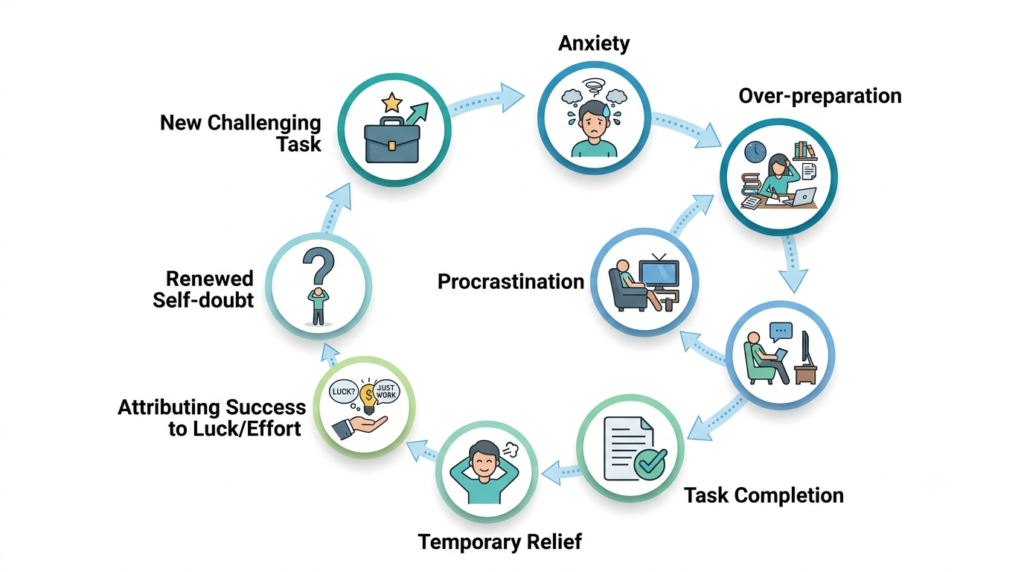
The imposter cycle model helps explain why these feelings can become self-reinforcing.
A typical cycle looks like this:
New task → Anxiety → Over-preparation or procrastination → Task completed → Temporary relief → Success attributed to luck or excessive effort → Imposter belief reinforced
The problem is not simply the original thought. It is the repeated behavioral cycle that prevents the person from learning a healthier interpretation of success.
The Anxiety Loop: Over-Preparation vs. Procrastination
When an important assignment appears, someone experiencing imposter feelings may react in two apparently opposite ways.
Over-preparation:
They spend excessive hours researching, checking, editing, and preparing because they believe anything less than perfection will expose their inadequacy.
Procrastination:
They delay beginning because the possibility of failure feels threatening.
Although these behaviors look different, they can serve the same psychological purpose: protecting the person’s self-image.
After completing the task, temporary relief arrives. But if the person concludes, “I only succeeded because I worked twice as hard as everyone else,” the underlying belief remains intact.
How Perfectionism and Personality Traits Feed the Loop
Perfectionism can intensify imposter feelings by creating unrealistic standards.
A perfectionistic person may interpret:
- One mistake as failure.
- Constructive criticism as proof of incompetence.
- Average performance as unacceptable.
- Difficulty as evidence of insufficient intelligence.
Personality characteristics associated with emotional sensitivity can also influence how strongly people react to mistakes and uncertainty.
Cognitive distortions and automatic thoughts can further strengthen the cycle. Common examples include all-or-nothing thinking, discounting positive evidence, catastrophizing, and mind-reading.
The Five Types of Imposter Syndrome
The popular five types of imposter syndrome are based on the framework associated with Valerie Young. These categories are useful for recognizing patterns, although they are not formal clinical diagnoses.
| Imposter Subtype | Core Mindset & Belief | Primary Behavioral Trigger |
|---|---|---|
| The Perfectionist | “It must be done 100% flawlessly.” | Minor errors feel like total failure. |
| The Natural Genius | “If I were smart, it would come easily.” | Struggling or practicing causes shame. |
| The Soloist | “I must accomplish this entirely on my own.” | Asking for help feels like fake competence. |
| The Expert | “I need to know every single piece of information.” | Not knowing one detail feels like proof of ignorance. |
| The Superhuman | “I must excel in every life role simultaneously.” | Pushing beyond healthy limits to prove worthiness. |
You may identify with more than one pattern, and your dominant pattern can change depending on your environment.
What Causes Imposter Syndrome?
There is no single cause. The psychology of imposter syndrome can develop through a combination of personality, learning experiences, family expectations, social comparison, workplace culture, and stressful transitions.
Childhood Development and Mindsets
Early experiences can shape how people define competence.
Children who receive strong praise mainly for being “smart” may become afraid of situations where they could struggle. Academic pressure, comparison with siblings or classmates, unrealistic expectations, or conditional approval can also influence later self-evaluation.
The distinction between a fixed vs. growth mindset, associated with psychologist Carol Dweck’s work, is particularly relevant.
A fixed mindset treats ability as something relatively stable.
A growth mindset emphasizes that skills can develop through learning, practice, feedback, and persistence.
Someone with rigid beliefs about intelligence may interpret difficulty as:
“I am not naturally good at this.”
A growth-oriented interpretation is:
“This is difficult because I am still learning.”
The Dunning-Kruger Effect Comparison
The Dunning-Kruger effect is often mentioned alongside imposter syndrome, but the concepts should not be treated as opposites.
The Dunning-Kruger effect concerns how people with limited knowledge in a domain may overestimate their competence.
Imposter feelings involve capable individuals underestimating or discounting their competence.
Real-world confidence is more complicated than a simple confidence-versus-competence scale, so neither concept should be used to label people casually.
Workplace Culture, Bias, and Non-Belonging
Environment matters.
A workplace with unrealistic expectations, poor feedback, intense competition, discrimination, systemic bias, or limited representation can increase feelings of not belonging.
Experiences involving systemic bias and microaggressions may make some people question whether they truly belong—even when their performance is strong.
Therefore, imposter feelings should not always be treated as an individual’s personal thinking problem. Sometimes the surrounding environment genuinely needs to change.
Can Imposter Syndrome Lead to Burnout?
Persistent imposter feelings can contribute to burnout and emotional exhaustion, especially when people respond by constantly overworking or hiding difficulties.
How Chronic Masking Can Cause Job Exhaustion
Maintaining an “expert mask” can be exhausting.
Someone may feel pressure to:
- Never admit they do not know something.
- Work longer than colleagues.
- Avoid asking questions.
- Say yes to every opportunity.
- Recheck completed work repeatedly.
- Hide mistakes rather than learning from them.
Over time, this can create an unhealthy relationship with achievement.
Importantly, imposter syndrome is not the only cause of burnout. Workload, lack of control, inadequate support, poor management, financial pressure, and unhealthy workplace conditions can all contribute.
Evaluating Your Experience
The Clance Impostor Phenomenon Scale (CIPS) is a commonly discussed research and self-assessment measure associated with imposter feelings.
A self-assessment can help someone reflect on patterns, but it should not be treated as a medical diagnosis.
If your feelings of inadequacy are persistent or significantly affecting your life, a qualified mental health professional can help determine what is actually happening.

How to Overcome Imposter Syndrome
Understanding the psychology of imposter syndrome is useful, but awareness becomes more valuable when it leads to action.
Use Cognitive Restructuring Techniques
Cognitive restructuring is a practical technique used in cognitive behavioral approaches to examine unhelpful thoughts.
Try this five-step exercise:
1. Identify the thought
“I am not qualified to lead this project.”
2. Identify the emotion
“I feel anxious and exposed.”
3. Separate feelings from evidence
Feeling unqualified is not proof of being unqualified.
4. List objective evidence
Write down qualifications, previous results, relevant experience, feedback, completed projects, or skills.
5. Create a balanced thought
“I have areas to learn, but I also have enough experience and skills to handle this responsibility.”
The goal is not unrealistic positive thinking. It is evidence-based thinking.
How to Stop Feeling Like a Fraud at Work
Instead of asking, “Do I feel confident enough?” ask:
“What evidence shows that I can reasonably handle this task?”
You can also:
- Keep an achievement log.
- Record positive feedback.
- Track measurable results.
- Ask for specific performance feedback.
- Discuss expectations with your manager.
- Set realistic definitions of “good enough.”
- Stop treating every mistake as an identity statement.
Confidence often grows from repeated evidence, not from waiting until fear disappears.
Overcoming Imposter Syndrome as a New Manager
Promotions can trigger imposter feelings because the role changes faster than your identity does.
You do not need to know everything simply because you became a manager.
A useful approach is to shift from:
“I must have every answer.”
to:
“My job is to help the team find good answers.”
Strong managers ask questions, delegate, seek expertise, communicate clearly, and make decisions with incomplete information.
Learn to Receive Positive Feedback
If praise makes you uncomfortable, avoid immediately minimizing it.
Instead of:
“It was nothing.”
Try:
“Thank you. I put a lot of effort into that, and I’m glad it helped.”
You do not have to agree with every compliment. Simply allowing positive feedback to exist without arguing against it is a useful step toward internalizing success.
A Practical Guide: Reframe Your Internal Dialogue Today
Use this simple checklist:
- Identify the subtype: Notice whether you are behaving like the Perfectionist, Soloist, Expert, Natural Genius, or Superhuman.
- Separate fact from feeling: Write “I feel unqualified,” then list three objective facts demonstrating your competence.
- Adopt a growth mindset: Replace “I don’t know how to do this” with “I haven’t mastered this yet.”
- Track achievements: Keep a document containing positive feedback, measurable results, completed projects, and milestones.
- Talk about it: Share experiences with trusted colleagues or mentors. Imposter feelings often become stronger when they remain hidden.
Most importantly, do not use this checklist to create another perfectionistic task. You do not need to “overcome imposter syndrome perfectly.”
Conclusion: From Fraudulence to Authentic Confidence
The psychology of imposter syndrome reveals an important distinction: feeling like a fraud is not evidence that you are one.
Imposter feelings often develop when people discount achievements, interpret difficulty as incompetence, rely on perfectionistic standards, or struggle to accept positive evidence about themselves.
Understanding the pattern makes it easier to interrupt it.
Instead of asking, “How can I prove that I am good enough?” try asking:
“What evidence do I already have that I am capable—and what can I learn next?”
That shift moves the goal from proving your worth to developing your abilities.
If imposter feelings are causing substantial distress or contributing to anxiety, exhaustion, or burnout, consider speaking with a qualified mental health professional. Cognitive behavioral strategies, supportive conversations, realistic goal-setting, and structured self-reflection can all help build a healthier relationship with achievement.
Frequently Asked Questions
Yes. Persistent imposter feelings can cause people to avoid opportunities, overwork, hesitate to speak up, or underestimate their qualifications. Recognizing these patterns can help people make more balanced career decisions.
Imposter feelings can occur among high achievers because success does not automatically change negative beliefs about competence. Some people continue to explain their achievements through luck, timing, or excessive effort rather than recognizing their abilities.
Perfectionism can reinforce imposter feelings by creating unrealistic standards. When even small mistakes are interpreted as evidence of incompetence, a person may continually feel that they have not done enough.
A useful starting point is to identify negative thoughts, compare them with objective evidence, track achievements, develop a growth mindset, and discuss persistent concerns with a trusted professional or mentor.

“Hi, I am Umer Hasib. I am a passionate blogger and content creator who loves exploring human psychology, social behaviors, and personal growth. Welcome to my inner space!”
Julia Robert
“This breakdown of the ‘Imposter Cycle’ hits so close to home! I’ve spent years thinking my success was just down to good timing or pure luck, especially when transitioning into a management role. Understanding the cognitive distortions behind over-preparation vs. procrastination gives me a concrete starting point to challenge those thoughts. Thank you for such an insightful read!”
“Thanks for the kind words, Sarah! It’s amazing how many high achievers silently go through the exact same struggle. You earned your management position through skill and hard work, not just luck! I’m so glad the article gave you actionable tools to reframe those thoughts. Rooting for your continued success!”
Dr. Marcus Vance
“An exceptional article on a topic that affects far too many high achievers in silence. Highlighting the distinction between clinical anxiety and imposter phenomenon, along with actionable cognitive restructuring techniques, makes this both academically grounded and practically useful. I’ll definitely be bookmarking this to share with my mentees.”
“Appreciate your thoughtful comment, Dr. Vance! You’re so right—far too many people suffer through this in silence, thinking it’s an isolated flaw rather than a recognized psychological pattern. Thank you for passing this along to the next generation of leaders and mentees!”