
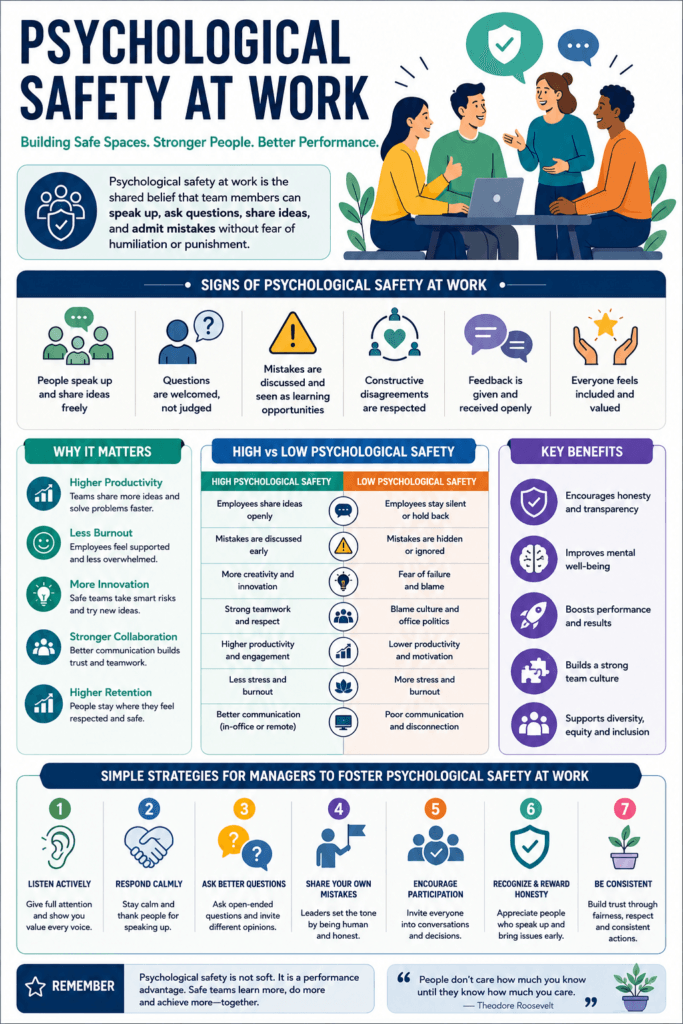
Psychological safety at work is the shared belief that team members can speak up, ask questions, share ideas, and admit mistakes without fear of humiliation or punishment. It helps reduce burnout, improve trust, and support better performance. In high-performing teams, psychological safety at work creates stronger communication, healthier collaboration, and more resilient workplace culture.
Introduction
In modern workplaces, success is no longer only about talent, speed, or productivity. High-performing teams also need trust, openness, and the freedom to speak honestly. That is where psychological safety at work becomes essential.
Psychological safety at work means employees feel safe enough to share ideas, ask questions, express concerns, and make mistakes without fear of embarrassment or punishment. This environment encourages learning, collaboration, and innovation. It also helps reduce stress and burnout, which are major problems in many organizations today.
Whether a team works in an office or remotely, psychological safety influences how people communicate, solve problems, and perform under pressure. This article explains what psychological safety at work really means, how it differs from trust, how it affects burnout and productivity, and what managers can do to build it.
What Is Psychological Safety at Work?
Psychological safety at work is a workplace condition where people feel comfortable being themselves without fear of negative consequences for speaking up. It is not about avoiding accountability. It is about creating an environment where people can communicate honestly and respectfully.
When psychological safety exists, employees are more likely to:
- Share new ideas
- Admit mistakes early
- Ask for help
- Raise concerns
- Participate actively in discussions
Why It Matters in Modern Workplaces
Today’s workplaces move fast. Teams are expected to innovate, collaborate across time zones, and solve problems quickly. Without psychological safety, people may stay silent even when they notice risks or better solutions.
That silence can hurt performance, teamwork, and long-term growth.
How to Build Psychological Safety at Work for High-Performing Teams
High-performing teams do not become strong by accident. They are built through consistent communication, respect, and shared accountability. Psychological safety at work is one of the strongest foundations for that success.
Encourage Open Communication
Team members should know that speaking honestly is welcomed. Managers can support this by asking open-ended questions, inviting feedback, and responding thoughtfully rather than defensively.
Normalize Mistakes as Part of Learning
Employees are more likely to take healthy risks when mistakes are treated as learning opportunities instead of public failures. This does not mean lowering standards. It means improving responses to error.
Lead with Respect and Consistency
People feel safe when leaders behave predictably and fairly. Respectful communication, clear expectations, and fair treatment all contribute to a safer team culture.
Reward Contribution, Not Just Perfection
When only flawless performance is praised, employees may hide problems. Recognizing effort, problem-solving, and thoughtful input creates a healthier environment for growth.
The Role of Psychological Safety at Work in Preventing Employee Burnout
Burnout often grows in workplaces where employees feel unsupported, unheard, or afraid to speak up about pressure. Psychological safety at work can reduce that risk in a very real way.
Why Burnout Develops in Unsafe Environments
When people fear judgment, they may:
- Work longer hours silently
- Hide stress
- Avoid asking for help
- Push themselves beyond healthy limits
Over time, this creates emotional exhaustion and mental fatigue.
How Safety Reduces Burnout
Psychological safety gives employees room to be honest about workload, stress, and mistakes. That openness makes it easier to solve problems early, redistribute tasks, and prevent overload before it becomes burnout.
A Healthier Culture Supports Sustainability
Teams that feel safe tend to recover faster from pressure because members communicate earlier and more openly. That makes the workplace more sustainable over time.
Key Characteristics of Psychological Safety at Work in Remote Teams
Remote work offers flexibility, but it can also create distance, confusion, and isolation. Psychological safety at work is especially important in remote teams because communication depends heavily on digital tools.Clear and Respectful Communication
Remote employees need clarity. Written messages, meeting tone, and response patterns all shape whether people feel safe.
Inclusion in Conversations
Remote workers can easily feel overlooked. Psychological safety improves when everyone is invited to contribute, not just the loudest voices in the room.
Freedom to Speak Up in Virtual Settings
In remote teams, people may hesitate to speak during video calls or chats. Leaders can help by directly inviting opinions and making it normal to ask questions.
Trust Without Micromanagement
Remote psychological safety grows when managers trust employees to do their work without constant surveillance. Excessive monitoring often increases anxiety instead of performance.
Psychological Safety at Work vs. Trust: What’s the Difference?
Many people use these terms as if they mean the same thing, but they are different.
| Psychological Safety at Work | Trust |
|---|---|
| Group/team environment concept | Person-to-person relationship |
| Feeling safe to speak up without fear | Belief that someone is reliable |
| Encourages questions and learning | Encourages confidence in someone |
| Allows mistakes without humiliation | Builds faith in actions/intentions |
| Helps innovation and creativity | Helps stability and relationships |
| Exists in team culture | Exists between individuals |
| Focused on communication safety | Focused on reliability and honesty |
| Improves collaboration in meetings | Improves long-term cooperation |
| Can exist even if trust is low | Can exist even if safety is low |
| Built by leadership behavior and policies | Built by consistency and experience |
Trust is often about confidence in another person’s reliability, honesty, or competence. Psychological safety at work is about whether people feel safe to speak up, make mistakes, and be themselves in a group.
How Trust and Safety Overlap
Trust and psychological safety support each other. When trust is high, people are usually more willing to speak. When safety is high, trust often grows faster.
The Main Difference
A team may trust a manager to be competent but still not feel safe enough to challenge ideas or share concerns. That is why both concepts matter.
Why This Difference Matters for Leaders
Managers who understand this distinction can build stronger teams. They do not just aim to be trusted; they create conditions where people feel psychologically safe to participate fully.
Impact of Low Psychological Safety at Work on Employee Productivity
Low psychological safety can quietly damage productivity. When employees do not feel safe, they often hold back ideas, avoid risk, and spend energy managing fear instead of doing their best work.
| High Psychological Safety | Low Psychological Safety |
|---|
| Employees share ideas openly | Employees stay silent |
| Mistakes are discussed early | Mistakes are hidden |
| More creativity and innovation | Fear-based working culture |
| Strong teamwork and respect | Blame and office politics |
| Higher productivity | Lower performance |
| Less burnout | More stress and burnout |
| Better remote collaboration | Poor communication in remote teams |
| Feedback is normal Feedback feels risky |
Lower Participation
Employees may stop sharing suggestions or speaking honestly in meetings. That means valuable ideas are lost.
More Mistakes Hidden
When people fear blame, they may hide errors instead of addressing them early. Small issues then become larger and more expensive problems.
Reduced Creativity and Innovation
Innovation requires experimentation. If the workplace feels unsafe, employees will choose the safest path instead of the smartest one.
Less Ownership and Engagement
People do better work when they feel respected and heard. Low psychological safety often leads to disengagement, silence, and lower morale.
Practical Examples of Psychological Safety at Work in Action
Psychological safety is not just a theory. It shows up in everyday workplace behavior.
Example 1: A Team Member Admits a Mistake Early
Instead of hiding a problem, an employee says something went wrong. The team addresses it quickly and learns from it. That is psychological safety in action.
Example 2: A New Hire Asks a “Basic” Question
In unsafe workplaces, new employees may pretend to understand everything. In a psychologically safe team, they feel comfortable asking questions that help them learn faster.
Example 3: A Worker Challenges an Idea Respectfully
Healthy teams allow disagreement without punishment. When someone questions a plan in a constructive way, the team improves decision-making.
Example 4: A Manager Invites Honest Feedback
A leader asks, “What am I missing?” and genuinely listens. That simple habit can make people feel respected and included.
Simple Strategies for Managers to Foster Psychological Safety at Work
Managers play a huge role in shaping workplace culture. Small daily actions can have a big impact on psychological safety at work.
Ask Better Questions
Instead of only asking for updates, ask:
- What concerns do you have?
- What would make this easier?
- What ideas have not been shared yet?
These questions invite honest dialogue.
Respond Calmly to Bad News
If employees bring problems early, reward that honesty. Reacting with anger teaches people to hide issues next time.
Show That Different Opinions Are Welcome
Healthy teams do not need everyone to agree. They need people to feel safe enough to disagree respectfully.
Share Your Own Mistakes
When leaders admit their own mistakes, it lowers fear and increases openness. It shows that learning matters more than pretending to be perfect.
Make Feedback Routine
Feedback should not only happen during annual reviews. Regular, constructive conversations build confidence and trust.
How Psychological Safety at Work Supports Long-Term Team Success
Psychological safety is not just good for employee comfort. It is a serious performance advantage.
Better Problem Solving
Teams that communicate honestly solve problems faster because issues are surfaced earlier.
Stronger Collaboration
People collaborate better when they know their voice matters. That improves coordination and reduces conflict.
Higher Retention
Employees are more likely to stay in workplaces where they feel respected, heard, and supported.
Better Adaptation to Change
Change is easier when people feel safe enough to ask questions and share uncertainty. That makes the team more flexible and resilient.
Conclusion
Psychological safety at work is one of the most important foundations of a healthy, high-performing workplace. It creates an environment where employees can speak honestly, learn from mistakes, ask for help, and contribute ideas without fear. That kind of culture improves communication, reduces burnout, strengthens remote teams, and supports long-term productivity.
The difference between a team that simply works and a team that truly thrives often comes down to safety. When employees feel protected from humiliation or blame, they become more engaged, more creative, and more willing to take the kinds of risks that lead to real progress.
Managers and leaders do not build psychological safety through slogans. They build it through everyday behavior: listening carefully, responding fairly, encouraging questions, and treating mistakes as learning opportunities. Over time, these simple actions create trust, resilience, and stronger results.
In the long run, psychological safety at work is not just a “nice to have.” It is a serious workplace advantage that helps people and organizations perform better together.
FAQs
What are the signs of psychological safety at work?
Signs include open communication, honest feedback, willingness to ask questions, constructive disagreement, and comfort admitting mistakes.
Can psychological safety improve remote team performance?
Yes. It helps remote workers communicate more openly, feel included, and avoid silent confusion or disengagement.
How can managers build psychological safety quickly?
Managers can start by listening without judgment, responding calmly to problems, inviting feedback, and showing that different opinions are welcome.

“Hi, I am Umer Hasib. I am a passionate blogger and content creator who loves exploring human psychology, social behaviors, and personal growth. Welcome to my inner space!”