
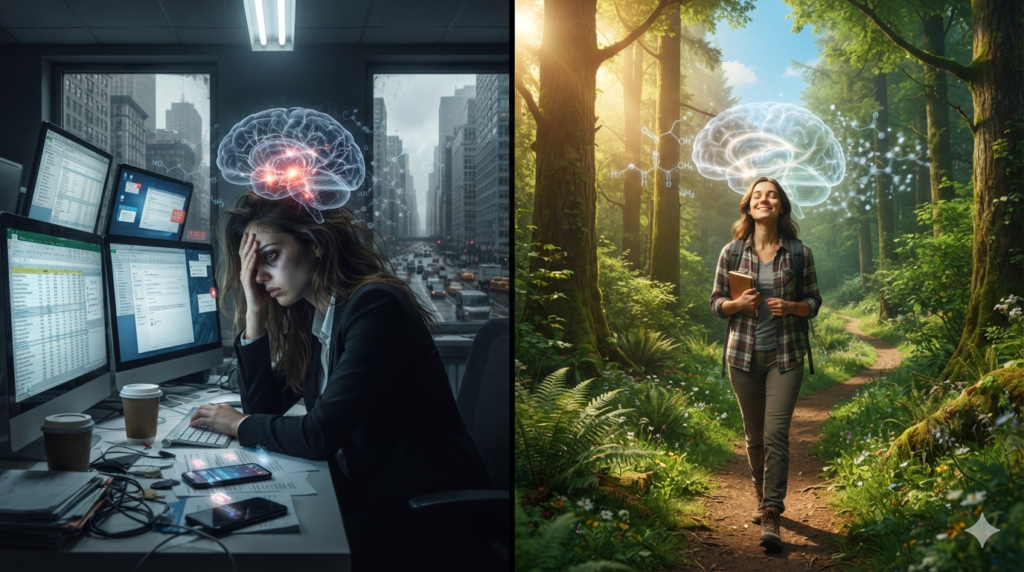
SEO Featured Snippet
The psychological effects of nature deficit include chronic stress, poor concentration, anxiety, emotional exhaustion, and reduced mental resilience. Scientific research shows that spending time in green spaces improves cognitive performance, lowers stress hormones, and supports emotional well-being. Even short daily exposure to nature can significantly improve mental health.
Introduction
Have you ever ended a long day feeling mentally exhausted—even though you barely left your chair? Do endless notifications, artificial lighting, and hours spent indoors leave you feeling emotionally drained without knowing why?
You’re not alone.
Modern lifestyles have dramatically changed how humans interact with nature. Many people spend over 90% of their time indoors, surrounded by concrete buildings, digital screens, and artificial environments. While technology has made life more convenient, it has also created an invisible mental health challenge that psychologists now recognize as one of the most overlooked issues of urban living.
These psychological effects of nature deficit go far beyond simply “wanting fresh air.” A prolonged lack of exposure to natural environments can reduce attention span, increase stress, weaken emotional regulation, and even contribute to anxiety and depression.
Environmental psychologists believe humans evolved alongside forests, rivers, mountains, and open skies. Our brains are naturally wired to respond positively to these environments. When that connection disappears, our mental well-being often suffers in subtle yet powerful ways.
In this guide, you’ll discover:
- What nature deficit really means
- The warning signs your mind may be disconnected from nature
- The science behind green spaces and brain health
- Practical ways to restore psychological balance through everyday outdoor experiences
Let’s begin by identifying the hidden signs.
Signs You Are Suffering from Nature Deficit
Many people mistake the symptoms of nature deprivation for ordinary stress or burnout. However, your environment may be playing a much bigger role than you realize.
Nature deficit doesn’t happen overnight. It develops gradually as daily routines become increasingly centered around indoor living, digital devices, artificial lighting, and limited contact with green spaces.
Common warning signs include:
- Constant mental fatigue
- Difficulty concentrating
- Feeling emotionally overwhelmed
- Increased irritability
- Poor sleep quality
- Persistent stress
- Lack of motivation
- Reduced creativity
- Feeling disconnected from the world around you
- Low emotional resilience
If several of these symptoms sound familiar, your brain may simply be craving something it evolved to need: nature.
Identifying Nature Deficit Disorder Symptoms
Although Nature Deficit Disorder isn’t an official medical diagnosis, psychologists and environmental health researchers use the term to describe the growing disconnect between humans and natural environments.
The resulting nature deficit disorder symptoms often affect both physical and mental well-being.
Mental Symptoms
- Brain fog
- Reduced attention span
- Difficulty making decisions
- Emotional numbness
- Increased anxiety
- Chronic worrying
- Poor memory retention
- Cognitive fatigue
One reason for this mental exhaustion is the lack of restorative environmental stimulation. Experts studying cognitive fatigue relief methods explain that the human brain continuously processes artificial information—emails, advertisements, traffic, social media, and notifications—without receiving the calming sensory input that natural environments provide.
Unlike urban settings, forests, parks, and gardens allow the brain’s directed attention system to recover naturally.
Emotional Symptoms
Nature deprivation may also contribute to:
- Mood swings
- Emotional burnout
- Feeling disconnected
- Reduced happiness
- Increased frustration
- Low emotional resilience
Many people describe these feelings as living on “mental autopilot.”
Physical Symptoms
The psychological effects of nature deficit frequently extend into physical health, causing:
- Chronic headaches
- Poor sleep
- Muscle tension
- Low energy
- Eye strain from screens
- Elevated stress hormones
These symptoms often improve once people regularly reconnect with outdoor environments.
Why Am I Constantly Feeling Trapped Indoors?
One of the most common questions people ask today is:
“Why do I always feel trapped indoors even when I’m home?”
The answer lies in the way modern environments affect the human brain.
Our ancestors evolved in dynamic natural settings filled with changing colors, sunlight, flowing water, birdsong, fresh air, and open landscapes. Today’s urban environments are almost the complete opposite.
Instead, we experience:
- Concrete walls
- Artificial lighting
- Limited natural sounds
- Screen exposure
- Air-conditioned rooms
- Repetitive indoor routines
Over time, this can create feelings similar to sensory deprivation in urban areas, where the brain receives less of the diverse, calming stimulation it naturally expects.
This disconnect doesn’t necessarily cause claustrophobia in the clinical sense, but many people experience:
- Restlessness
- Mental confinement
- Increased anxiety
- Emotional exhaustion
- A constant desire to “get away”
Researchers studying urbanization and mental health suggest that densely populated cities often expose people to chronic noise, pollution, visual clutter, and continuous cognitive demands. These factors increase psychological stress while reducing opportunities for mental restoration.
Even looking through a window at trees has been shown to produce measurable improvements in mood compared to viewing concrete structures alone.
What Happens to the Brain Without Nature?
The human brain wasn’t designed to process endless digital stimulation without periods of natural recovery.
Nature serves as one of the brain’s most effective restoration systems. Without it, cognitive performance gradually declines while stress responses become more active.
Scientists studying environmental psychology continue to find strong evidence that regular exposure to green environments supports healthier brain function.
Let’s examine why.
The Science Behind How Lack of Green Space Affects Mental Health
One of the strongest scientific explanations comes from the Attention Restoration Theory (ART) developed by psychologists Rachel and Stephen Kaplan.
According to Attention Restoration Theory Kaplan, modern life constantly demands directed attention—the mental effort required to focus on work, screens, emails, studying, and multitasking.
This mental system eventually becomes exhausted.
Natural environments restore attention differently.
Instead of forcing concentration, nature gently captures our awareness through birdsong, moving leaves, flowing water, clouds, and natural scenery. Psychologists refer to this as “soft fascination.”
As a result, the brain can recover from cognitive overload without requiring conscious effort.
Research on psychological well-being green spaces has associated regular exposure to parks, forests, gardens, and natural landscapes with:
- Better concentration
- Improved memory
- Faster mental recovery
- Enhanced creativity
- Lower stress levels
- Greater emotional stability
Brain imaging studies also suggest that spending time in green environments reduces activity in regions linked to repetitive negative thinking, while strengthening networks involved in emotional regulation and cognitive flexibility.
For office workers, students, and professionals, even short outdoor breaks during the day may improve productivity and reduce mental fatigue.
Can Nature Deficit Cause Depression and Anxiety?
Although nature deficit alone doesn’t directly cause clinical depression or anxiety disorders, growing evidence suggests it can significantly increase the risk and worsen existing symptoms.
The connection lies in how natural environments influence brain chemistry.
Limited exposure to sunlight may reduce vitamin D production and disrupt circadian rhythms, both of which play important roles in regulating mood and sleep. At the same time, chronic indoor living often means less physical activity, fewer restorative experiences, and ongoing exposure to digital stressors.
From the perspective of the Biophilia Hypothesis in environmental psychology, humans possess an innate tendency to seek connections with nature and other living systems. When this connection is weakened, emotional well-being can decline over time.
Studies have linked regular access to green spaces with:
- Lower symptoms of anxiety
- Reduced risk of depression
- Improved emotional resilience
- Better sleep quality
- Greater life satisfaction
- Higher overall psychological well-being
Researchers also note that natural settings can reduce rumination—the cycle of repetitive negative thoughts that often fuels anxiety and depression.
In contrast, prolonged exposure to noisy, overcrowded, and highly urbanized environments may amplify stress responses, making emotional recovery more difficult.
The encouraging news is that reconnecting with nature, even in small daily doses, can help counter many of these psychological effects and support long-term mental health.

Why Do I Feel Better When Outdoors? The Healing Power of Green Spaces
Have you ever noticed how a short walk in a park can leave you feeling calmer, clearer, and more energized than spending the same amount of time scrolling on your phone?
This isn’t your imagination—it’s neuroscience.
One of the most fascinating discoveries in environmental psychology is that the human brain responds differently to natural environments than it does to urban settings. Trees, flowing water, fresh air, and natural sounds activate biological systems that encourage recovery rather than constant alertness.
For people experiencing the psychological effects of nature deficit, even brief outdoor exposure can improve mood, sharpen focus, and reduce mental exhaustion.
Green spaces offer several therapeutic benefits:
- Lower stress responses
- Improved concentration
- Better emotional regulation
- Enhanced creativity
- Increased energy levels
- Greater sense of connection and purpose
Unlike digital entertainment, nature doesn’t overload the brain with information. Instead, it provides gentle, restorative stimulation that allows your nervous system to reset naturally.
How Does Nature Reduce Stress Hormones?
One of nature’s greatest healing abilities is its effect on the body’s stress response.
When we experience ongoing pressure from work, deadlines, traffic, or excessive screen time, the brain activates the fight-or-flight response, releasing stress hormones such as cortisol and adrenaline.
While these hormones are helpful during emergencies, chronically elevated levels can lead to:
- Anxiety
- High blood pressure
- Poor sleep
- Fatigue
- Weakened immunity
- Difficulty concentrating
Research on cortisol levels in natural environments shows that spending time in parks, forests, beaches, or gardens helps reduce cortisol more effectively than remaining in busy urban settings.
Why Green Spaces Calm the Brain
Natural environments engage the parasympathetic nervous system—often called the “rest and digest” system—which slows the heart rate, relaxes muscles, and promotes emotional recovery.
Several factors contribute to this calming effect:
- Natural sunlight supports healthy serotonin production.
- Fresh air improves oxygen delivery to the brain.
- Green landscapes reduce sensory overload.
- Birdsong and flowing water create soothing auditory stimulation.
- Walking outdoors encourages gentle physical activity, releasing endorphins.
These combined effects explain why many people feel noticeably calmer after spending time outside.
Stress Recovery Theory Explained
Another influential concept is the Stress Recovery Theory, which proposes that humans recover from psychological stress more quickly when exposed to natural environments than to artificial ones.
According to this theory:
- Nature lowers physiological stress.
- Blood pressure begins to stabilize.
- Heart rate decreases.
- Mental tension fades more quickly.
- Emotional resilience improves.
This explains why even a 15–20 minute walk through a tree-lined area can produce measurable improvements in mood and relaxation.
Forest Bathing Health Benefits Explained
One of the most scientifically supported ways to reconnect with nature is the Japanese practice of Shinrin-yoku, commonly known as forest bathing.
Despite its name, forest bathing doesn’t involve water.
Instead, it means intentionally immersing yourself in a forest environment using all five senses.
During a forest bathing session, you might:
- Walk slowly without a destination.
- Observe leaves, trees, and wildlife.
- Listen to birds and rustling branches.
- Smell the natural scents of wood and soil.
- Feel the breeze or sunlight on your skin.
The goal is not exercise but mindful presence.
Proven Forest Bathing Health Benefits
Research has associated forest bathing health benefits with a wide range of improvements, including:
- Lower cortisol levels
- Reduced anxiety
- Improved mood
- Better immune function
- Enhanced focus
- Lower blood pressure
- Improved sleep quality
- Greater emotional well-being
Scientists believe that phytoncides—natural compounds released by trees—may also contribute to some immune-supporting effects, although more research is ongoing.
Ecotherapy for Anxiety Management
Forest bathing is one example of ecotherapy for anxiety management, a therapeutic approach that uses nature as part of mental health care.
Ecotherapy can include:
- Nature walks
- Gardening
- Hiking
- Outdoor mindfulness
- Wildlife observation
- Beach walks
- Green exercise (walking or cycling in parks)
Many therapists now encourage clients to combine traditional treatment with regular outdoor experiences because nature can complement stress management and emotional healing.
It’s important to remember that ecotherapy is not a replacement for professional mental health treatment, but it can be a valuable supportive practice.
What Is the Remedy for Nature Deficit Disorder?
The good news is that recovering from the psychological effects of nature deficit doesn’t require moving to a forest or spending hours outdoors every day.
Small, consistent habits often produce meaningful improvements over time.
The most effective remedies include:
- Spending time in local parks.
- Walking outdoors without your phone.
- Exercising in natural environments.
- Taking lunch breaks outside.
- Opening windows for fresh air.
- Watching sunrises or sunsets.
- Gardening.
- Bringing natural elements into your home.
- Reducing unnecessary screen time.
- Scheduling weekly visits to green spaces.
Consistency matters far more than occasional long trips into nature.
How Much Time Outside Fixes Nature Deficit?
A common question is:
How much nature exposure is actually enough?
Research suggests that spending approximately 120 minutes per week in natural environments is associated with better health and psychological well-being. This doesn’t have to happen all at once—it can be spread across several days.
Examples include:
- 20 minutes per day for six days.
- Two 60-minute weekend walks.
- Four 30-minute park visits.
- Short daily outdoor breaks combined with weekend activities.
The key is making outdoor time a regular habit rather than an occasional event.
Screen Time vs. Nature Time Outcomes
| Daily Habit | Likely Mental Outcome |
|---|---|
| 8+ hours screen time, little outdoor exposure | Increased mental fatigue, higher stress, reduced focus |
| 6 hours screen time + 20 minutes in nature | Improved concentration and reduced stress |
| Regular outdoor exercise | Better mood, higher energy, improved sleep |
| 120 minutes of nature weekly | Stronger psychological well-being and emotional resilience |
| Daily green space exposure | Better attention span and lower anxiety levels |
This simple comparison highlights how balancing screen time with nature can significantly improve mental health.
Making Nature Part of Your Routine
If you live in a city with limited green space accessibility, try these ideas:
- Walk through the nearest park before work.
- Eat lunch outdoors when possible.
- Take phone calls while walking outside.
- Visit botanical gardens or nature reserves on weekends.
- Choose tree-lined routes instead of busy streets.
- Spend a few quiet minutes in a garden or courtyard.
Even small changes can help reverse the psychological effects of nature deficit over time.
How to Cure Nature Deficit in Children
Children today are growing up in a world filled with smartphones, tablets, video games, and online learning. While technology offers many educational benefits, excessive screen time often replaces outdoor exploration, increasing the risk of nature deficit.
Studies suggest that children who spend more time outdoors tend to have better attention spans, stronger emotional regulation, improved physical health, and greater creativity. By reducing the gap between children’s screen time vs nature, parents can support healthier development.
Practical Ways to Reduce Nature Deficit in Children
Parents don’t need expensive vacations or wilderness adventures. Simple daily habits can make a lasting difference.
1. Schedule Daily Outdoor Play
Aim for at least 30–60 minutes of unstructured outdoor play whenever possible. Parks, backyards, playgrounds, or neighborhood walks all count.
2. Limit Recreational Screen Time
Set healthy boundaries around phones, tablets, and gaming devices. Replace some screen-based entertainment with outdoor family activities.
3. Encourage Nature-Based Learning
Instead of only reading about nature, let children experience it by:
- Watching birds
- Collecting leaves
- Planting flowers
- Exploring local parks
- Learning about insects
- Observing changing seasons
Hands-on experiences strengthen curiosity and improve memory.
4. Become a Role Model
Children imitate adults. If parents regularly choose outdoor walks over scrolling through social media, children are more likely to adopt similar habits.
5. Make Weekends Nature Days
Plan family outings to:
- Nature reserves
- Botanical gardens
- Lakes
- Beaches
- Hiking trails
- Public parks
Creating positive memories outdoors helps children develop lifelong appreciation for nature.
Benefits of Bringing Nature Inside Your Home
Not everyone has easy access to forests or large parks. Fortunately, you can still reduce the psychological effects of nature deficit by incorporating natural elements into your indoor environment.
While indoor nature isn’t a complete replacement for outdoor experiences, it can improve mood, reduce stress, and create a more calming atmosphere.
Add Indoor Plants
Houseplants not only enhance interior design but also provide a visual connection to nature.
Popular low-maintenance options include:
- Snake Plant
- Peace Lily
- Spider Plant
- Pothos
- ZZ Plant
Research suggests that indoor greenery may help reduce stress and improve workplace satisfaction.
Maximize Natural Light
Open curtains during the day and arrange your workspace near windows whenever possible.
Natural daylight supports:
- Healthy sleep cycles
- Better mood
- Increased productivity
- Improved energy levels
Use Natural Materials
Wood furniture, stone décor, bamboo accessories, and earthy colors create environments that feel more relaxing than sterile, artificial spaces.
Listen to Nature Sounds
Birdsong, rainfall, ocean waves, or flowing streams can help create a calming atmosphere, especially during work or meditation sessions.
Although researchers continue studying can virtual nature improve your mood, evidence suggests that natural sounds and realistic nature imagery can provide modest psychological benefits when outdoor access is limited. However, they work best as a supplement—not a substitute—for real nature.
Create a Green Workspace
If you work from home:
- Place plants near your desk.
- Position your desk close to a window.
- Take short outdoor breaks every hour.
- Use natural lighting whenever possible.
- Add nature-inspired artwork or photography.
These simple adjustments can reduce mental fatigue and improve focus throughout the day.
Conclusion: Steps to Reclaim Your Psychological Well-Being
The psychological effects of nature deficit are becoming increasingly common as modern life shifts toward indoor living, urban environments, and constant digital engagement. Chronic stress, poor concentration, emotional exhaustion, and reduced mental resilience are not always signs of personal weakness—they may also reflect a lack of meaningful connection with the natural world.
The encouraging news is that recovery doesn’t require dramatic lifestyle changes. Consistent exposure to green spaces, daily outdoor walks, mindful time in nature, and even small indoor changes can gradually restore emotional balance and cognitive performance.
Whether you choose a five-minute walk beneath the trees, practice forest bathing on weekends, or simply open your windows to let in fresh air and sunlight, every step strengthens your connection with nature and supports long-term mental well-being.
Your challenge starts today: Step away from your screen for just five minutes, breathe deeply, notice the sky, the trees, or the breeze around you. Small moments of nature, repeated consistently, can have a lasting impact on your mind.
Frequently Asked Questions (FAQs)
Yes. Spending too much time indoors and away from natural environments can reduce focus, creativity, and problem-solving abilities. Regular outdoor breaks have been linked to improved concentration, mental clarity, and overall workplace performance.
Research suggests that people with easier access to parks and green spaces often report lower stress levels, better emotional well-being, and higher life satisfaction. Frequent contact with nature may help protect against chronic psychological stress.
Pets can encourage outdoor activity, reduce loneliness, and improve emotional well-being—especially dogs that require regular walks. While they don’t replace direct exposure to nature, they can motivate healthier outdoor routines.
Yes. Sunshine often boosts mood through vitamin D production and healthy circadian rhythms, but even on cloudy days, time spent outdoors can reduce stress and improve focus. The key is consistent exposure to natural environments rather than waiting for perfect weather.

“Hi, I am Umer Hasib. I am a passionate blogger and content creator who loves exploring human psychology, social behaviors, and personal growth. Welcome to my inner space!”
“Modern life keeps us glued to screens, but our brains are wired for the wild. This striking visual perfectly captures the invisible weight of ‘Nature Deficit Disorder’ vs. the instant cognitive relief of stepping into green spaces. How many hours a day do you spend trapped behind a desk compared to walking outdoors? Let’s talk about urban burnout below.
“The contrast in this visual is so powerful. It’s scary how we’ve normalized living in a ‘concrete jungle’ at the expense of our mental peace. I’m definitely guilty of 9+ hours of screen time daily. This is a much-needed reminder that stepping outside isn’t a luxury; it’s a biological necessity for our minds to heal.
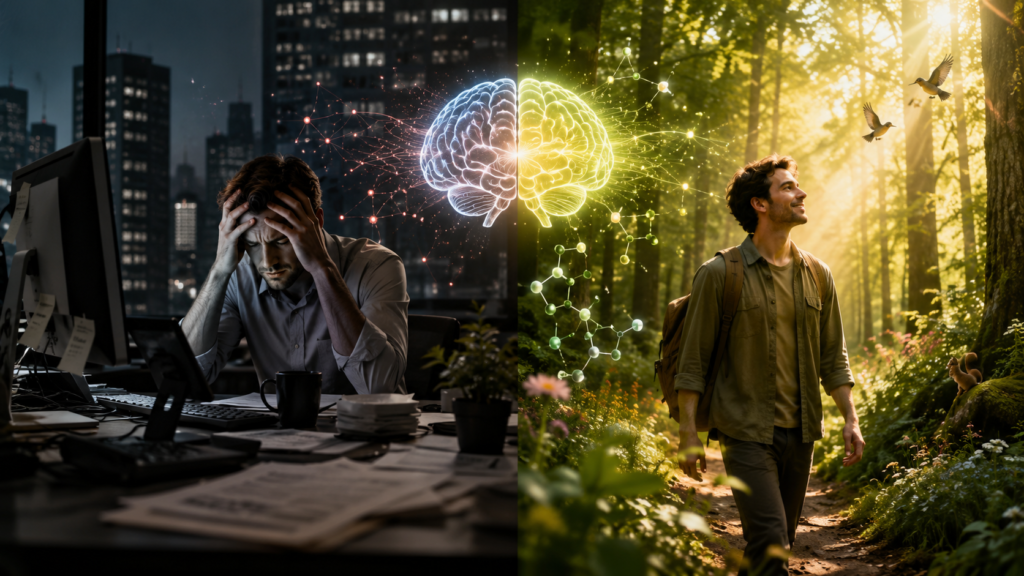
“The science of wellness in one image. On the left: urbanization, sensory overload, and spiking cortisol levels. On the right: Attention Restoration Theory (ART) in action through simple forest immersion. Our latest article breaks down the profound psychological shifts that happen when you exchange concrete jungles for real ones. Read the full architectural breakdown at the link in our bio!
“Incredible breakdown! The concept of Attention Restoration Theory (ART) is so fascinating, and this visual represents it flawlessly. It’s amazing how our brains literally change when we step away from sensory overload and into natural light. Definitely heading to the bio to read the full article!