

Escape Financial Insecurity by stabilizing your cash flow, identifying essential expenses, building emergency savings, reducing expensive debt, and increasing reliable income. Start with one manageable financial priority instead of trying to fix everything at once. Over time, consistent saving, spending control, debt reduction, income growth, and long-term investing can turn financial stress into greater stability and freedom.
Intoduction
Financial insecurity can make even an ordinary month feel like a crisis.
You may earn a reasonable income but still worry about the next unexpected bill. You may work hard every day while feeling that your money disappears almost as quickly as it arrives. A car repair, medical expense, job interruption, family emergency, or large bill can suddenly put your entire budget under pressure.
The important thing is this:
Financial insecurity is not always a personal failure. It is often a financial-system problem.
When income is unstable, essential expenses consume most of your cash flow, debt payments remain high, and savings are too small, financial pressure can continue even when you are working hard.
The good news is that your financial position can change.
You do not need one dramatic financial decision. You need a system that gradually gives you more control over your money.
This guide explains how to escape financial insecurity, build a personal financial safety net, manage debt, increase income, protect yourself from financial shocks, and eventually move toward financial independence.

Why You Feel Financially Insecure Even When You Work Hard
Financial insecurity usually develops when your financial obligations are stronger than your financial protection.
You might have a job and still feel insecure because your income is inconsistent, your expenses are rising, or you have little money available when something unexpected happens.
Financial well-being is more than simply earning a certain amount. The Consumer Financial Protection Bureau describes financial well-being in terms of controlling day-to-day finances, being able to absorb financial shocks, staying on track with goals, and having freedom of choice.
Understand the Real Causes of Financial Insecurity
Several factors can create financial insecurity:
- Unstable or unpredictable income
- High housing costs
- Rising essential monthly expenses
- Credit-card or high-interest debt
- Lack of emergency savings
- Irregular expenses
- Lifestyle inflation
- Dependence on one income source
- Poor cash-flow planning
- Unexpected financial emergencies
Imagine someone earning $3,000 per month.
If essential expenses consume $2,600 and debt payments consume another $300, only $100 remains.
That person is technically earning $36,000 annually, but their financial system has almost no breathing room.
This is why income alone does not determine financial security.
The better question is:
How much financial flexibility remains after essential obligations are paid?
To understand how to escape financial insecurity, start by identifying the exact point where your money is being absorbed.
How Financial Stress Affects Your Decisions
Money anxiety can influence financial behavior.
When people feel financially threatened, they may focus only on immediate survival. Long-term planning becomes harder because the next bill feels more important than the next five years.
This can lead to decisions such as:
- Using credit for routine expenses
- Delaying important bills
- Ignoring account balances
- Making emotional purchases for temporary relief
- Taking expensive loans
- Avoiding financial statements
- Selling long-term assets too quickly
- Constantly moving money around without a plan
The goal is not to eliminate every financial worry overnight.
Instead, learn how to stop financial stress by replacing uncertainty with information and a simple system.
Start by knowing:
- How much money comes in.
- How much goes toward essentials.
- How much goes toward debt.
- How much you save.
- What financial risks could disrupt your plan.
Understanding your numbers can make financial problems feel more manageable.
Are You Living Paycheck to Paycheck?
You may be living paycheck to paycheck if:
- Your income is mostly spent before the next payday.
- A small emergency requires borrowing.
- You regularly use credit for necessities.
- You have little or no emergency savings.
- You delay bills until payday.
- Your monthly budget depends on everything going perfectly.
- You cannot handle a temporary income reduction.
Living paycheck to paycheck is not necessarily solved simply by “spending less.”
Sometimes the deeper issue is that essential expenses are too high relative to income.
That is why a better approach combines expense control, savings, debt management, and income improvement.
How to Become Financially Secure Starting From Where You Are
You do not need to wait until you earn more money to begin.
Your first goal should be to understand your current financial position and create a small amount of breathing room.
Calculate Your Essential Monthly Expenses
Start with the expenses you genuinely need to maintain basic living and financial obligations.
Your list may include:
| Category | Examples |
|---|---|
| Housing | Rent, mortgage, basic housing costs |
| Food | Groceries and essential meals |
| Utilities | Electricity, water, gas, internet |
| Transportation | Fuel, public transport, essential maintenance |
| Insurance | Health, auto, home, life or other relevant coverage |
| Debt | Required minimum payments |
| Healthcare | Necessary medical costs and prescriptions |
| Family obligations | Essential support or caregiving expenses |
Separate these from optional lifestyle expenses.
For example:
Essential: rent, groceries, electricity, transportation.
Optional: premium subscriptions, frequent restaurant meals, impulse shopping, unnecessary upgrades.
This distinction gives you a clearer picture of your financial survival number.
Build a Personal Financial Safety Net
A personal financial safety net is the combination of savings, insurance, manageable debt, reliable income, and other resources that help you handle financial shocks.
Emergency savings are particularly important because unexpected expenses can otherwise become expensive debt. The CFPB recommends building dedicated emergency savings for unplanned expenses and notes that even small amounts can provide some financial security.
Instead of obsessing over one universal savings number, build your emergency fund in stages:
Stage 1: Create a small starter reserve.
Stage 2: Build enough savings to cover several weeks of essential expenses.
Stage 3: Work toward a larger reserve appropriate for your income stability, family responsibilities, debt, and risk exposure.
Someone with highly variable income may need a larger cash buffer than someone with stable employment and strong workplace benefits.
The important thing is to start.
Create Your First Financial Stability Plan
A simple financial stability plan can follow four priorities:
- Control essential cash flow
- Build emergency savings
- Reduce expensive debt
- Increase reliable income
This answers the question of how to build financial stability without making the process unnecessarily complicated.
Do not attempt to optimize every financial decision simultaneously.
First create stability.
Then create protection.
Then focus on growth.

How to Stop Financial Emergencies From Destroying Your Progress
A financial emergency becomes especially damaging when there is no reserve available to absorb it.
Without savings, an unexpected bill can lead to credit-card debt, loans, missed payments, or withdrawals from long-term savings.
The CFPB notes that emergency savings can help people recover from unexpected expenses and reduce reliance on credit or loans that can become more expensive through interest and fees.
Build an Emergency Fund Before Investing Aggressively
Investing can be an important part of long-term wealth building, but your financial foundation matters first.
If you have no accessible savings and an emergency forces you to sell investments or borrow money, your long-term plan becomes more fragile.
Your emergency fund should generally be:
- Accessible
- Relatively low risk
- Separate from everyday spending
- Easy to understand
- Large enough to provide meaningful protection
A practical financial emergency fund planning approach is to begin with a small target and increase it gradually.
For example:
Starter goal → one essential expense → several weeks of essentials → several months of essentials
The right amount depends on your personal circumstances.
Protect Yourself From Unexpected Financial Shocks
Emergency savings are only one layer of protection.
Consider the other parts of your financial defense system:
- Appropriate insurance
- Manageable debt
- Multiple income possibilities
- Important financial documents
- Cash reserves
- Reliable banking access
- Backup plans for major expenses
Learning how to protect yourself financially means reducing the number of events that could completely disrupt your financial life.
Insurance can transfer some major risks, while savings can handle smaller unexpected expenses.
The exact insurance products you need depend on your location, family situation, assets, employment, and legal requirements.
Financial Emergency Protection Checklist
Use this checklist to identify weaknesses in your financial safety net:
- Calculate essential monthly expenses
- Set an emergency savings target
- Open or designate a separate emergency savings account
- Review insurance coverage
- List all debt obligations
- Identify your highest-interest debts
- Identify at least one potential backup income source
- Keep important financial documents organized
- Review beneficiaries where appropriate
- Know how to access your important financial accounts
FDIC guidance on preparing finances for emergencies also emphasizes maintaining emergency savings and organizing important financial documents and account information.
How to Escape the Debt Cycle and Regain Control
Debt is not automatically a sign of financial failure.
The problem occurs when debt payments consume so much of your cash flow that you cannot build savings or respond to emergencies.
High-cost debt can create a cycle:
Low savings → emergency → borrowing → higher payments → less savings → greater vulnerability
Breaking that cycle requires both repayment and financial protection.
Choose Effective Debt Management Strategies
Start by creating a complete debt inventory.
Record:
- Creditor
- Balance
- Interest rate
- Minimum payment
- Due date
- Type of debt
Then compare your options.
Two common repayment approaches are:
Debt avalanche: Focus extra money on the highest-interest debt first while maintaining minimum payments on other debts.
Debt snowball: Focus extra money on the smallest balance first to create quick psychological wins.
The mathematically efficient choice may differ from the behaviorally motivating choice.
The best strategy is one you can consistently follow without abandoning your basic financial needs.
Reduce Liabilities Without Destroying Your Budget
A common mistake is sending every available dollar toward debt while leaving yourself with zero emergency savings.
That can create a new problem.
Suppose you pay an extra $500 toward debt but have nothing available for an urgent $600 repair the following month.
You may end up borrowing again.
A stronger approach balances:
Essential expenses + minimum debt payments + emergency savings + extra debt repayment
Once your emergency reserve becomes stronger, you can increase the amount directed toward high-cost debt.
Recover From Financial Setbacks Without Starting Over
Job loss, unexpected medical costs, major repairs, family emergencies, or poor financial decisions can temporarily damage your finances.
A setback does not erase all your progress.
When something goes wrong:
- Protect essential expenses first.
- Pause nonessential spending.
- Contact creditors before missing payments when possible.
- Use emergency savings for genuine emergencies.
- Review available income sources.
- Rebuild your emergency reserve after the crisis.
- Reassess your financial plan.
The question is not:
“Why did I fail?”
Ask:
“What part of my financial system needs to become stronger?”
That mindset makes how to recover from financial setbacks a practical planning question rather than a personal judgment.

How Living Below Your Means Creates Financial Security
Living below your means does not mean eliminating everything enjoyable.
It means consistently spending less than you earn so that some income remains available for savings, debt reduction, investing, and future goals.
Reduce Spending Without Making Life Miserable
Start with spending categories that have a meaningful impact.
Look for:
- Unused subscriptions
- Excessive convenience spending
- Frequent impulse purchases
- Expensive recurring commitments
- Lifestyle upgrades you do not truly value
- Fees that can be avoided
- Purchases made primarily from habit
Do not cut everything equally.
Instead, protect spending that genuinely improves your life and reduce spending that provides little value.
This makes living below your means more sustainable.
Build a Sustainable Monthly Money System
A sustainable money system can look like this:
Income → Essentials → Minimum obligations → Savings → Debt reduction → Flexible spending
You can automate savings where appropriate. FDIC consumer guidance notes that automatic transfers can help people save consistently, while CFPB resources also emphasize regular saving as a useful habit.
At the end of each month, review:
- Total income
- Essential expenses
- Discretionary spending
- Debt payments
- Savings
- Unexpected expenses
You are not trying to achieve a perfect month.
You are trying to create a repeatable system.
Turn Monthly Savings Into Long-Term Wealth
Once you consistently generate surplus cash, that money can eventually support longer-term wealth building strategies.
The progression can be:
Monthly surplus → emergency savings → debt reduction → investing → asset growth
Your exact investment choices should depend on your goals, risk tolerance, time horizon, tax situation, and local financial system.
The principle is simple:
Financial security begins when you stop consuming every dollar you earn.
How to Increase Income and Reduce Financial Dependence
Reducing expenses has a limit.
Income can often provide another powerful route toward financial stability.
If your essential expenses already consume most of your income, endlessly cutting small expenses may not solve the underlying problem.
Build Multiple Income Sources
Potential income sources may include:
- Primary employment
- Freelancing
- Consulting
- Small business activity
- Digital products
- Professional services
- Part-time work
- Skill-based projects
The goal is not to create ten side hustles.
The goal is to reduce dependence on one fragile income source when practical.
These are examples of income diversification strategies, not guarantees of additional income.
Choose opportunities that match your skills, available time, legal requirements, and financial goals.
Strengthen Your Financial Position Through Better Income
One of the most powerful long-term financial strategies can be increasing your earning capacity.
Consider:
- Learning valuable skills
- Improving professional qualifications
- Negotiating compensation
- Applying for higher-value roles
- Building a portfolio
- Developing specialized expertise
- Expanding your professional network
A small increase in income can have a larger impact when you avoid immediately increasing your lifestyle spending by the same amount.
That extra cash can instead strengthen your savings, debt repayment, or investment plan.
Create a Backup Income Strategy
Ask yourself:
“If my main income stopped for three months, what would I do?”
Your answer does not need to be perfect.
Create a basic backup plan:
- Emergency savings
- Updated résumé or professional profile
- Marketable skills
- Professional contacts
- Potential freelance or temporary work
- A list of expenses that could be reduced quickly
This turns income diversification strategies into practical preparation rather than a vague financial goal.
How to Build Financial Resilience for an Uncertain Future
Financial resilience means being better prepared to absorb problems without completely losing control.
You cannot predict every emergency.
You can prepare your financial system to respond better.
Create a Long-Term Financial Plan
A long-term plan should connect several areas:
Emergency savings + debt reduction + insurance + investing + future goals
Start with your current position.
Then define:
- Where you are now
- Where you want to be
- What financial risks could interfere
- What monthly amount you can realistically save
- What debts you want to eliminate
- How your income could increase
- When you can begin or expand investing
This is the foundation of long term financial planning.
Learn How to Manage Money During Uncertainty
During economic or personal uncertainty, flexibility becomes valuable.
If your income falls, temporarily prioritize:
- Housing
- Food
- Utilities
- Healthcare
- Transportation
- Insurance
- Essential debt obligations
Then reduce or pause lower-priority spending where possible.
How to manage money during uncertainty is ultimately about protecting cash flow and preserving options.
Do not make every financial decision based on fear.
Make decisions based on your actual numbers.
Measure Your Financial Progress Regularly
Track a few simple indicators:
| Financial Measure | What It Tells You |
|---|---|
| Monthly savings | Whether you are creating surplus |
| Emergency fund | Your ability to absorb shocks |
| Debt balance | Whether liabilities are declining |
| Income | Your earning capacity |
| Essential expenses | Your minimum monthly requirement |
| Net worth | Your overall financial position |
| Investment assets | Your long-term growth base |
Review these numbers monthly or quarterly.
Progress is easier to see when you measure it.
That is a core part of financial resilience planning.
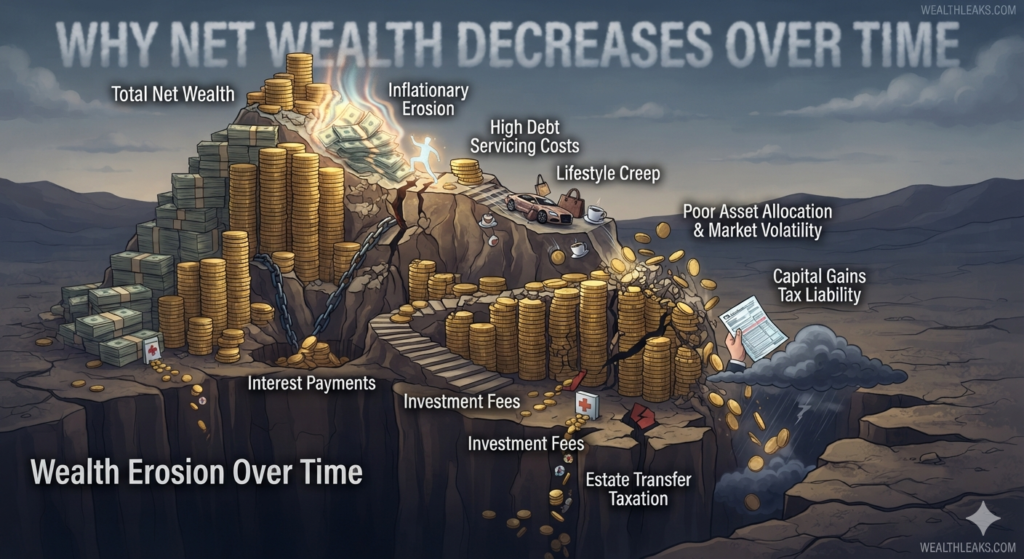
From Financial Security to Financial Independence
Financial security and financial independence are related, but they are not the same.
Security means having greater control and protection.
Independence means eventually having enough assets and/or reliable income sources to give you greater freedom from dependence on active employment.
Start Building Wealth After Stabilizing Your Finances
Aggressive wealth building becomes easier when your foundation is stable.
Before focusing heavily on long-term investing, consider whether you have:
- Basic emergency savings
- A manageable debt strategy
- Controlled essential expenses
- Appropriate insurance
- Reliable cash flow
Once those foundations are stronger, you can devote more attention to long-term wealth building strategies.
Create a Financial Independence Strategy
Financial independence planning can involve:
- Increasing your savings rate
- Growing income
- Reducing liabilities
- Investing consistently
- Building productive assets
- Avoiding unnecessary lifestyle inflation
- Increasing your financial knowledge
The goal is not necessarily to become wealthy overnight.
It is to gradually increase the percentage of your life that is supported by assets and financial resources rather than only by active income.
Turn Financial Stability Into Long-Term Freedom
Think of the journey as a progression:
Financial insecurity
↓
Financial stability
↓
Emergency safety net
↓
Debt control
↓
Income growth
↓
Wealth building
↓
Financial independence
Every stage supports the next.
You do not need to jump from financial stress directly to financial freedom.
You need to move one stage forward at a time.
How to Escape Financial Insecurity: Your Action Plan
Knowing what to do is useful.
Knowing what to do this week is better.
Here is a practical roadmap.
Your First 30 Days
Focus on understanding and stabilizing your finances.
Week 1 — Know your numbers
- Calculate monthly income.
- Calculate essential monthly expenses.
- List all debts.
- Review subscriptions and recurring payments.
- Check recent spending.
Week 2 — Stop financial leakage
- Cancel unnecessary recurring costs.
- Reduce avoidable spending.
- Create realistic spending limits.
- Separate essential and discretionary expenses.
Week 3 — Start your safety net
- Create or designate an emergency savings account.
- Set a small initial savings target.
- Automate a manageable transfer if possible.
- Direct suitable windfalls toward savings.
Week 4 — Build your debt plan
- List interest rates.
- Identify high-cost debt.
- Choose an appropriate repayment strategy.
- Keep minimum obligations current.
- Avoid creating new unnecessary debt.
Your Next 90 Days
Once the basics are under control, focus on strengthening your financial position.
Your priorities should include:
- Building consistent savings
- Increasing your emergency reserve
- Starting debt reduction
- Reviewing insurance
- Improving income
- Developing a backup income option
- Tracking monthly cash flow
- Reviewing financial progress
Do not measure success only by how much money you have.
Measure whether your financial system is becoming more resilient.
Your 12-Month Financial Security Roadmap
Set five measurable targets:
- Emergency fund target
- Debt reduction milestone
- Income growth goal
- Investment or wealth-building goal
- Financial independence milestone
Your roadmap can look like this:
| Stage | Main Goal | Key Action |
|---|---|---|
| 1 | Stabilize | Control essential expenses |
| 2 | Protect | Build emergency savings |
| 3 | Recover | Reduce expensive debt |
| 4 | Grow | Increase income and assets |
| 5 | Build | Invest consistently |
| 6 | Progress | Work toward financial independence |
The numbers should be personalized to your income, expenses, debt, family responsibilities, location, and financial goals.
Conclusion: Take the First Step to Escape Financial Insecurity
You do not escape financial insecurity through one perfect budget, one investment, or one dramatic financial decision.
You build your way out of it.
Start by controlling essential expenses.
Then create a personal financial safety net.
Reduce expensive debt.
Increase your earning capacity.
Protect yourself from major financial shocks.
Once your foundation becomes stronger, begin building long-term wealth and working toward financial independence.
The most important step is the one you can actually repeat.
Control expenses → Build a safety net → Reduce debt → Increase income → Build wealth → Pursue financial independence.
You do not have to fix your entire financial life today.
Choose one financial action today—calculate your essential expenses, open an emergency savings account, list your debts, cancel one unnecessary expense, or identify one way to increase income.
Small actions become powerful when they are repeated.
And repeated financial stability is how greater financial freedom is built.
Frequently Asked Questions About Financial Insecurity
The fastest practical approach is usually to stabilize cash flow first. Calculate essential expenses, stop major unnecessary financial leakage, build an initial emergency reserve, and create a plan for high-cost debt. If your income is insufficient to cover essentials, increasing income becomes just as important as reducing expenses.
Start by protecting essential expenses and building savings in small, consistent amounts. Track spending, reduce unnecessary recurring costs, address expensive debt, and look for realistic ways to increase income. You do not need a large income to begin improving financial security, but your plan must match your actual cash flow.
Practical action can reduce some of the uncertainty behind money anxiety. Know your essential monthly expenses, maintain even a small emergency reserve, organize your bills, and create a plan for unexpected costs. Financial security is not only about having a large balance; it is also about knowing what you can afford and having a plan when something goes wrong.
There is no single amount that works for everyone. Consider your essential monthly expenses, income stability, household responsibilities, debt, insurance coverage, and likelihood of unexpected costs. Start with an achievable amount and gradually increase the reserve as your financial position improves. CFPB guidance specifically notes that even small emergency savings can provide some financial security.

“Hi, I am Umer Hasib. I am a passionate blogger and content creator who loves exploring human psychology, social behaviors, and personal growth. Welcome to my inner space!”
Emily Carter:
“This article made financial security feel much more achievable. I especially liked the idea of building stability step by step instead of trying to fix everything at once. The 30-day and 90-day action plans are really practical!”
Thank you, Emily! I’m glad you found the step-by-step approach and the 30-day and 90-day action plans practical. Financial security really is built through small, consistent actions rather than trying to change everything overnight.
James Anderson:
“Great breakdown of financial insecurity. The connection between emergency savings, debt reduction, and increasing income really stood out to me. The financial security roadmap gives readers a clear direction instead of just general advice.”
Thank you, James! I really appreciate your thoughtful feedback. Emergency savings, debt reduction, and income growth work best together because each strengthens the overall financial foundation. I’m glad the roadmap gave you a clear and practical direction.