
Featured Snippet:
Why kids love Diana comes down to a combination of relatable child performers, colorful visuals, simple pretend-play stories, expressive acting, toy-based surprises, and sibling interaction. Kids Diana Show makes videos feel less like traditional cartoons and more like watching a familiar playmate, while repetition and easy-to-follow storytelling make the content especially engaging for preschool audiences.
Decoding the Obsession: Why Is Kids Diana Show So Popular with Toddlers?
Parents often wonder why their children can watch the same Diana video repeatedly while losing interest in other programs after only a few minutes. The answer is not one single trick. Kids Diana Show combines several characteristics that naturally attract young viewers: familiar faces, simple stories, bright visual design, pretend play, repetition, music, toys, and exaggerated emotional expressions.
The channel is built around entertainment that is easy for young children to understand without requiring complicated dialogue or a long attention span. Diana and other recurring characters participate in activities that resemble children’s everyday play—dressing up, exploring toys, pretending, solving simple problems, and interacting with family members.
That familiarity can make the screen experience feel socially meaningful rather than purely fictional.
The Psychology of Preschool Parasocial Relationships and Media Bonding
Young children are still developing their understanding of fictional characters, social relationships, and media. When they repeatedly see the same performer, they can begin to recognize that person, anticipate their expressions, and associate them with enjoyable experiences.
This helps explain preschool parasocial relationships and media bonding. A toddler does not necessarily think about Diana in the same sophisticated way an adult thinks about a celebrity. Instead, the child may experience her as a familiar presence who repeatedly appears during enjoyable playtime.
The effect can become stronger when videos contain:
- Familiar faces and recurring characters
- Repeated phrases and behaviors
- Familiar toys and settings
- Facial expressions that clearly communicate emotions
- Simple conflicts followed by easy resolutions
- Activities that children can imitate at home
This is closely connected with early childhood sensory stimulation and engagement. Young viewers are attracted to experiences that are visually obvious, emotionally clear, and easy to follow.
Why Diana Can Feel Like an Accessible Playmate
One important difference between a traditional animated character and a real child performer is physical relatability.
Diana moves through recognizable environments and performs actions that children themselves can imitate. A toddler can see someone dressing up, playing with a toy, pretending to be a superhero, or reacting dramatically to a surprise.
That creates an important psychological bridge:
“I am watching someone play” → “I understand what they are doing” → “I could play that way too.”
This does not mean every child forms a genuine social relationship with the performer. Rather, the familiar presentation can make the content feel socially accessible.
Why Young Kids Prefer Watching Real Child Creators Over Traditional Cartoons
Traditional cartoons remain extremely popular, but real-child entertainment offers a different type of viewing experience.
A cartoon character can be visually appealing, but a real child has recognizable human movements, facial expressions, gestures, and reactions. Preschoolers are naturally learning by observing other people, making real-life demonstrations especially easy to imitate.
Pretend Play and Roleplay Video Dynamics
The pretend play and roleplay video dynamics used in Kids Diana Show can turn ordinary objects into imaginary worlds.
A box can become a house. A toy can become a character. A costume can transform a child into a princess, doctor, superhero, or explorer.
This is important because pretend play is already part of normal childhood development. When a video demonstrates a pretend scenario, children may not simply consume the story—they may reproduce parts of it during their own play.
The same principle appears in Roma and Diana sibling roleplay content, where sibling interactions provide another layer of social modeling.
Children can observe:
- How siblings react to one another
- How characters negotiate simple problems
- How toys are used in imaginary situations
- How emotions are expressed
- How a story progresses from problem to solution
The content therefore resembles a performance of play rather than a conventional cartoon narrative.
Sensory Hooks & Production Mechanics: What Makes Diana Videos So Engaging?
The answer to why kids love Diana is also partly found in the way the videos are produced.
Preschool viewers often have limited patience for complicated explanations. Successful children’s entertainment therefore tends to communicate quickly through visuals, sounds, movement, repetition, and obvious emotional cues.
Vibrant Visual Saturation and Sound Effects Editing
Kids Diana Show frequently uses highly noticeable colors, costumes, toys, props, music, and sound effects.
This creates what can be described as vibrant visual saturation and sound effects editing.
Common production features include:
- Bright primary and contrasting colors
- Large, easily recognizable objects
- Quick changes between activities
- Exaggerated facial expressions
- Playful sound effects
- Music and rhythmic transitions
- Visual emphasis on toys and costumes
- Repetition of recognizable actions
These elements can help direct a young viewer’s attention toward the most important action happening on screen.
The broader concept of early childhood sensory stimulation and engagement is useful here. The content provides multiple sensory signals at once—visual movement, music, speech, facial expressions, and physical action.
However, highly stimulating content should not automatically be confused with educational quality. Something can be extremely attention-grabbing without necessarily being developmentally valuable.
How Non-Verbal Storytelling Attracts Global Viewers
Another major strength is the use of facial expressions, gestures, body language, and visual storytelling.
A child does not always need to understand every spoken sentence to understand that:
- Someone is surprised.
- Someone is happy.
- A toy has been discovered.
- Something went wrong.
- A character wants something.
- A problem has been solved.
This is an example of universal non-verbal communication in children’s media.
Because so much of the story can be understood visually, the format can travel across language boundaries more easily than dialogue-heavy programming.
Dubbing and localization can then expand accessibility further. This combination of visual storytelling and multi-language dubbing and global audience reach has helped children’s franchises operate across international markets.
The Mechanics Behind the Fascination
The following table summarizes the major engagement mechanisms without suggesting that any single factor explains every child’s behavior.
| Trigger Category | On-Screen Mechanic | Possible Effect on Young Viewers |
|---|---|---|
| Visual Editing | Bright colors, quick transitions, expressive visuals | Captures attention and makes important actions easy to notice |
| Auditory Cues | Music, playful sounds and reactions | Adds emotional emphasis and reinforces memorable moments |
| Narrative Structure | Unboxing, dress-up, toy testing and roleplay | Encourages curiosity and imaginative participation |
| Peer Dynamics | Diana, Roma and family interactions | Provides examples of social behavior and play |
| Repetition | Familiar characters, formats and activities | Makes stories easier to anticipate and understand |
| Surprise | Mystery toys, boxes and unexpected reveals | Creates anticipation about what happens next |
The important distinction is that attention is not the same as addiction. A child repeatedly requesting a favorite program does not by itself establish a clinical addiction.
The Unboxing Effect: Why Do Toddlers Love Toy Unboxing and Pretend Play Videos?
Toy unboxing is another powerful component of children’s entertainment.
A sealed package creates a simple question:
“What is inside?”
That question is easy for a young child to understand, and the answer is delayed for a short period. The viewer therefore experiences anticipation followed by discovery.
Unboxing Videos and Toy Demonstration Psychology
The unboxing videos and toy demonstration psychology behind this format involves curiosity, prediction, surprise, and imitation.
Children can experience the excitement of opening something without actually owning it. This can be thought of as vicarious ownership: the child watches someone else discover and use a toy while mentally participating in the experience.
When the toy is then incorporated into pretend play, the video becomes more than a product reveal. It becomes a demonstration of how the object can be used in an imaginary story.
The Love, Diana franchise illustrates how entertainment and merchandising can overlap. pocket.watch describes Love, Diana as a broader franchise involving original shows, merchandise, games, and licensed products.
This commercial connection is important for parents to understand because children’s entertainment can simultaneously function as storytelling, branding, and product marketing.
Why Do Children Copy Behaviors Seen on Kids Diana Show?
The pretend play and roleplay video dynamics make imitation especially straightforward.
A child may see Diana perform an action and later reproduce it while playing with their own toys.
This reflects principles associated with observational learning: children can acquire behaviors by watching other people demonstrate them.
For example, a child might imitate:
- A facial expression
- A pretend scenario
- A phrase
- A toy activity
- A costume idea
- A sequence of actions
That does not mean every behavior is copied exactly or that every child responds in the same way.
It does mean parents can turn passive viewing into active play by asking questions such as:
“What do you think Diana will do next?”
or
“Can we make our own story with your toys?”
That simple transition—from watching to doing—can make media time more interactive.
Algorithms and Franchising: What Is the Secret Behind the Love Diana Brand?
The success of Kids Diana Show is not only about individual videos. Distribution, recommendations, branding, and licensing can also influence how easily viewers discover related content.
How YouTube Kids Recommends Videos
It is important to avoid the oversimplified claim that YouTube simply “pushes” one channel to children because it has high watch time.
According to YouTube’s current help documentation, recommendations in YouTube Kids can be influenced by a child’s viewing history and searches, along with the selected content setting. Recommended videos are selected algorithmically.
YouTube also states that autoplay can automatically play another related video based on viewing history when the feature is enabled. Autoplay is currently off by default in YouTube Kids.
This creates the possibility of a viewing chain:
Watch → Recommendation → Watch another video → More relevant recommendations
Parents can interrupt this cycle by turning autoplay off, using approved-content settings, or managing the child’s viewing environment.
YouTube also provides options to block videos or channels and use an “Approved content only” setting.
What Role Does Pocket.watch Play in Expanding the Franchise?
The growth of Love, Diana demonstrates how a successful children’s media property can expand beyond YouTube.
pocket.watch describes Love, Diana as a franchise spanning original shows, products, games, and licensing. Its official franchise page also describes a hybrid animated series and retail merchandise.
This represents child influencer franchising and merchandising in action.
The general business model can look like:
Digital videos → audience recognition → characters → licensing → toys/products → additional shows and games
This is why parents may encounter Diana not only on video platforms but also through toys, games, clothing, and other branded media.
A Parent’s Guide: Is Kids Diana Show Safe and Appropriate for Preschoolers?
There is no universal answer of “safe” or “unsafe” based solely on a channel name. Parents should evaluate individual videos, the child’s age, viewing habits, and how the content fits into the child’s wider routine.
Assessing Content Safety, Screen Time, and Child Entertainment Ethics
The American Academy of Pediatrics has emphasized age-appropriate media, co-viewing, and maintaining healthy offline activities. Its guidance has historically recommended limiting screen media for children ages 2–5 to about one hour per day of high-quality programming, with parents encouraged to watch with children.
For families using Kids Diana Show, practical habits include:
1. Watch together when possible.
Ask questions and connect the video to real-world play.
2. Avoid unlimited autoplay.
YouTube Kids allows parents to control autoplay, which is off by default.
3. Use parental controls.
YouTube Kids provides options such as blocking content, disabling search, and approving specific content.
4. Watch for commercial influence.
Toy-centered entertainment can blur the line between storytelling and marketing. Help children understand that seeing a toy does not mean they need to own it.
5. Protect active playtime.
Balance videos with outdoor activity, books, crafts, pretend play, family conversation, and hands-on exploration.
6. Pay attention to your child’s response.
If a child becomes unusually upset when viewing ends, repeatedly demands videos, or loses interest in ordinary activities, that is a useful signal to reassess the routine.
The healthiest approach is usually not to treat every screen experience as harmful or every children’s video as educational. Content, context, duration, and parental involvement all matter.
What Parents Can Learn From Why Kids Love Diana
Understanding why kids love Diana provides a useful lesson about modern children’s media.
The strongest children’s videos often combine:
- Familiar people
- Simple stories
- Repetition
- Bright visual cues
- Humor
- Music
- Pretend play
- Surprise
- Social interaction
- Easy imitation
These elements work together to make the content immediately understandable to preschool viewers.
But parents can borrow the good part of this formula without relying on screens.
For example, take a favorite Diana-style activity and recreate it offline:
Pretend toy shop
Let the child create a pretend shop with household objects.
Dress-up story
Create costumes from safe clothes and invent a family story.
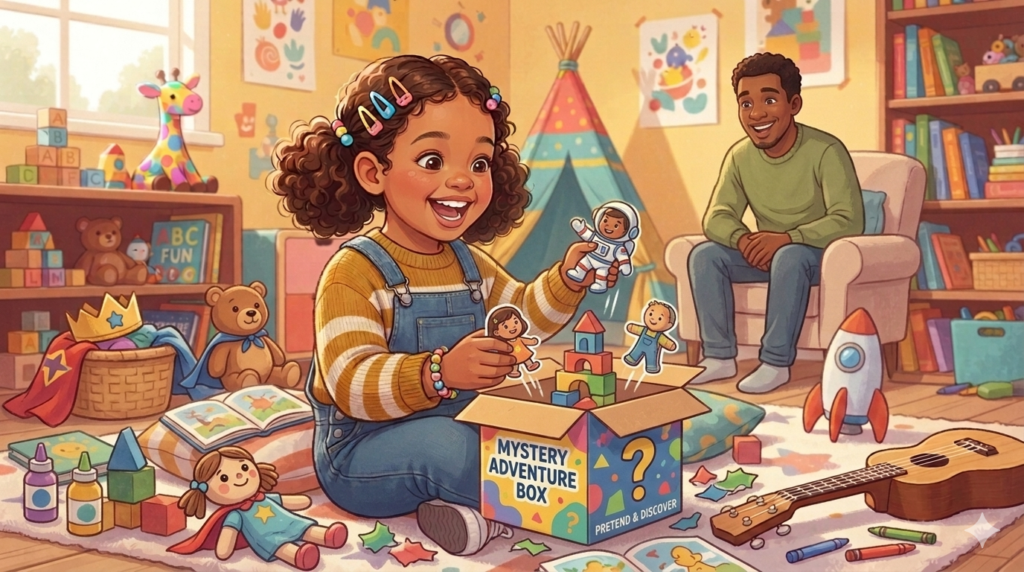
Toy unboxing
Hide a familiar toy inside a box and let the child discover it.
Video: Adventure story
Offline: Build a simple indoor obstacle course.
This turns media inspiration into active childhood play.
Frequently Asked Questions
1. Why does my child want to watch the same Diana video repeatedly?
Repetition can make content predictable and comforting. Young children often enjoy familiar stories because they know the characters, sequence, and expected outcome.
2. Is Kids Diana Show educational or mainly entertainment?
It is primarily entertainment, although individual videos may encourage language, imitation, imaginative play, or social discussion. Parents should not assume that colorful children’s content is automatically educational.
3. Can watching Diana influence a child’s behavior?
Children can imitate behaviors they observe in media, particularly simple actions and pretend-play routines. Co-viewing gives parents an opportunity to explain, redirect, or expand on what they see.
4. Should parents allow children to watch Kids Diana Show every day?
The answer depends on the child’s age and overall media routine. A better approach is to establish consistent limits and ensure screen viewing does not replace sleep, physical activity, family interaction, reading, or hands-on play.
Conclusion: Understanding the Modern Preschool Media Landscape
So, why kids love Diana is not a mystery with one magical answer.
Kids Diana Show combines relatable child performers, pretend play, expressive communication, colorful production, toys, surprise, repetition, and sibling interaction into a format that is extremely easy for young viewers to understand.
Its global appeal is also strengthened by visual storytelling, localization, platform recommendations, and the expansion of the Love, Diana franchise into additional entertainment and merchandise.
For parents, the most useful takeaway is not simply whether Diana is “good” or “bad.” The better question is how the content fits into a child’s overall life.
Use children’s videos as one part of a larger routine—not as a replacement for real-world play.
After the screen goes off, encourage children to do what Diana’s videos often inspire in the first place: pretend, explore, create, move, communicate, and play.
FAQs
Kids often enjoy Diana because the videos combine familiar child performers, colorful visuals, simple stories, pretend play, toys, music, and expressive reactions.
Suitability depends on the individual child and the specific video. Parents should consider age-appropriate content, screen-time limits, parental controls, and whether viewing is balanced with active play.
Children naturally learn through observation. Simple roleplay, facial expressions, phrases, and toy activities shown in videos can give children ideas for their own pretend play.
Many Diana videos feature dress-up, toys, roleplay, family interactions, and imaginative scenarios, which can give children ideas that they may recreate during offline play.

“Hi, I am Umer Hasib. I am a passionate blogger and content creator who loves exploring human psychology, social behaviors, and personal growth. Welcome to my inner space!”
Name: Sarah M.
This is such an insightful breakdown! As a parent, I’ve often wondered why my toddler is so captivated by Diana’s videos. Understanding the role of non-verbal storytelling, bright visual editing, and observational learning really puts things into perspective. It’s fascinating to see how media psychology and clever production choices work together to keep preschoolers so engaged.
Thank you so much, Sarah! You hit the nail on the head. It really is incredible how much thought goes into those simple-looking videos—from the exaggerated facial expressions to the high-contrast colors. Once you see the media psychology behind it, it all starts to make sense!
We’re so glad the breakdown helped bring some clarity. How do you usually balance her videos with offline pretend play at home? Would love to hear your thoughts!
Name: David L.
Great article! The breakdown of the business mechanics and algorithmic strategy behind the brand was especially interesting. It’s amazing how a family vlog expanded into a global franchise through smart licensing and universal storytelling. The tips for balancing screen time with active, real-world pretend play are super helpful for parents trying to navigate digital media today.
Thanks so much, David! The shift from a homemade family vlog to a global franchise with licensing partners like pocket.watch is definitely a masterclass in modern digital media. It proves how powerful universal, non-verbal content can be when paired with a strong distribution strategy.
I appreciate your kind words on the screen-time tips—finding that healthy balance between digital media and hands-on, creative play is so key for parents today. Thanks for reading and sharing your thoughts!