

Understanding dark night of soul means exploring a period of intense inner questioning, emotional distress, loss of meaning, and spiritual uncertainty that some people interpret as a transformative crisis. It is traditionally associated with mystical spirituality, but similar symptoms can overlap with depression, anxiety, trauma, or dissociation, so professional support may be important.
Introduction
Feeling disconnected from yourself, terrified by your own thoughts, or strangely empty can be deeply unsettling. You may wonder why the things that once gave your life meaning suddenly feel distant or meaningless.
The phrase understanding dark night of soul is often used to describe this kind of profound spiritual and psychological crisis. In spiritual traditions, it can represent a period of questioning, surrender, and transformation rather than a permanent failure or punishment.
However, it is important not to automatically label serious psychological symptoms as a spiritual awakening. A dark night of the soul is a spiritual framework, not a clinical diagnosis. Understanding the difference can help you approach the experience with both spiritual openness and practical care.
What Is a Dark Night of the Soul? Origins and Modern Meaning
The dark night of the soul is traditionally connected with the Spanish Christian mystic St. John of the Cross, who lived during the 16th century. His mystical writings described a difficult process in which a person’s attachments, expectations, and ordinary sources of spiritual comfort are gradually stripped away.
The classical idea was much more specific than the modern internet version of a “spiritual crisis.” Today, people often use the phrase to describe periods of intense transformation involving identity, purpose, relationships, beliefs, and emotional life.
Historical Roots in St. John of the Cross
St. John of the Cross described spiritual purification as a difficult movement toward deeper union with God. His famous poem Dark Night became closely associated with this process.
Modern interpretations have expanded the concept beyond Christian mysticism. Some people now use it as a metaphor for profound personal transformation, especially after major life changes.
The Ego Dissolution Process and Identity Collapse
During a major personal crisis, familiar identities can lose their strength.
A person may begin questioning:
- “Who am I without my career?”
- “What do I actually believe?”
- “Why doesn’t success make me happy anymore?”
- “What gives my life meaning?”
- “Which parts of my personality are authentic?”
This can resemble an ego dissolution process, where previously stable roles and beliefs no longer feel convincing.
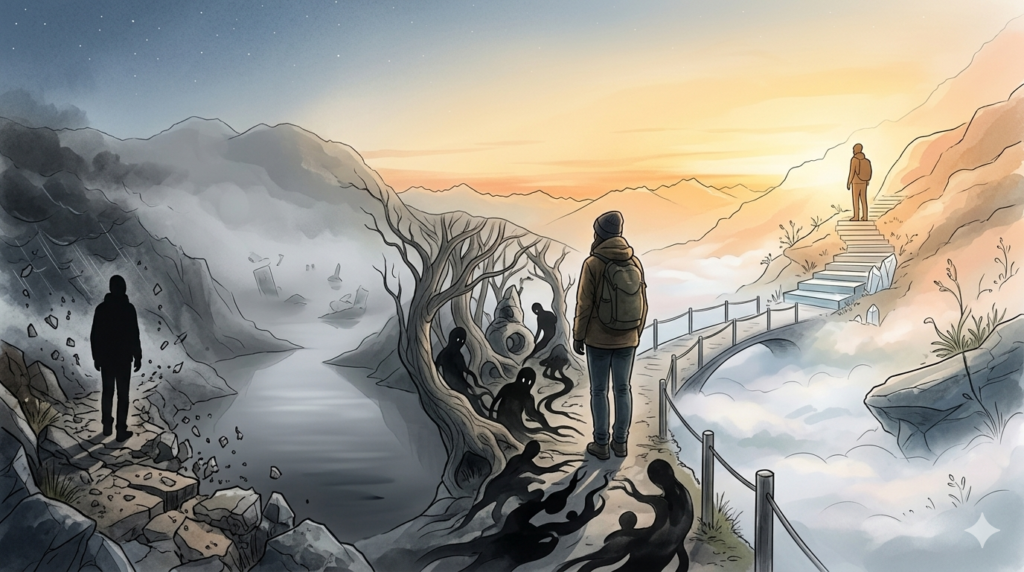
The resulting loss of meaning and purpose can be frightening. Some people also experience existential dread and isolation, particularly when they feel that others do not understand what they are going through.
Am I Experiencing Depression or Dark Night of the Soul?
This is one of the most important questions to address.
A spiritual interpretation should never replace professional assessment when someone is experiencing significant psychological symptoms.
| Metric / Dimension | Clinical Depression | Dark Night of the Soul |
|---|---|---|
| Primary framework | Mental-health condition with multiple possible causes | Spiritual or existential framework |
| Common experience | Persistent low mood, hopelessness, loss of interest | Spiritual uncertainty, questioning, desolation |
| Sense of self | May involve worthlessness or feeling broken | May involve questioning identity and old beliefs |
| Functioning | Can significantly impair daily functioning | Impact varies considerably |
| Appropriate response | Professional mental-health evaluation may be needed | Spiritual reflection may be meaningful alongside appropriate support |
There is also no scientifically validated test that can diagnose a “dark night of the soul.” Therefore, the safest approach is to treat spiritual interpretations as frameworks for meaning rather than medical diagnoses.
Depersonalization vs Spiritual Transformation
During intense distress, some people experience depersonalization—a sensation of being detached from themselves—or derealization, where the world feels unreal or dreamlike.
These experiences can be frightening.
Calling them spiritual transformation does not automatically make them harmless. If these sensations are persistent, severe, or interfering with daily life, speaking with a qualified mental-health professional is a sensible step.
This is especially important when discussing spiritual bypass in mental health—using spiritual explanations to avoid addressing trauma, depression, anxiety, dissociation, or another serious problem.
What to Do When Nothing Feels Real Anymore
If everything suddenly feels unreal, focus on the present moment rather than trying to understand the entire experience.
Try:
- Sit somewhere quiet and safe.
- Put both feet firmly on the floor.
- Slowly identify five things you can see.
- Notice four things you can physically feel.
- Take slow, comfortable breaths.
- Drink some water.
- Contact someone you trust.
Avoid making major life decisions while severely distressed.
What Causes a Dark Night of the Soul and Why Is It So Painful?
There is no single scientifically established cause of a “dark night of the soul.” In spiritual literature, however, people commonly associate these experiences with major disruptions in identity, relationships, beliefs, or life circumstances.
Can a Relationship Trigger a Dark Night of the Soul?
Yes, a relationship can act as a catalyst for intense personal questioning.
A breakup, betrayal, unrequited love, grief, or emotionally intense relationship may force someone to examine attachment, expectations, self-worth, and identity.
Some spiritual communities describe these experiences using terms such as “twin flame,” but these concepts should be treated as spiritual beliefs rather than established psychological facts.
Spontaneous Kundalini Awakening Symptoms and Energy Overload
Some spiritual traditions describe kundalini awakening as an energetic transformation.
People who interpret their experiences this way may report sensations such as:
- Unusual bodily sensations
- Changes in sleep
- Emotional intensity
- Increased sensitivity
- Tingling or warmth
- Periods of unusual energy
These experiences can have many possible explanations, including stress, anxiety, sleep disruption, medication effects, or physical health conditions.
Therefore, what are the physical symptoms of spiritual awakening is not a question with one medically established symptom list.
Why Does Spiritual Awakening Feel So Painful?
Transformation can feel painful because familiar beliefs and expectations may no longer provide the same sense of security.
A person may experience grief for an old identity while simultaneously feeling uncertain about the future.
From a psychological perspective, major transitions can create uncertainty and emotional stress. From a spiritual perspective, some traditions interpret this period as surrendering old attachments.
Both perspectives can be explored without assuming that every painful symptom has a spiritual cause.
The 5 Essential Dark Night of the Soul Stages
There is no universally accepted scientific model consisting of exactly five stages. The following framework is a practical spiritual model that can help readers organize their experience.
Stage 1 & 2: The Catalyst and Psychological Desolation
Stage 1 — The Breakdown
Something disrupts the old structure of life.
This might be:
- A breakup
- Bereavement
- Career loss
- Major disappointment
- Identity crisis
- Sudden change in beliefs
Stage 2 — The Void
The person may experience emptiness and uncertainty.
The goals that previously seemed important may suddenly feel irrelevant. This is often described as one of the dark night of the soul stages.
Stage 3 & 4: Shadow Integration and Ego Death
Stage 3 — The Descent
Attention turns inward.
Old fears, unresolved emotions, insecurities, and painful memories may become more noticeable. This is where carefully practiced shadow work can become useful.
Stage 4 — Surrender
Instead of constantly trying to return to the old identity, the person begins accepting uncertainty.
Learning how to stop resisting ego death does not mean destroying yourself psychologically. It means becoming less attached to identities, expectations, or beliefs that no longer fit.
Stage 5: Rebirth, Integration, and Soul Alignment
Stage 5 — Emergence
The person gradually develops a more integrated sense of identity.
They may experience greater curiosity, compassion, emotional flexibility, and clarity.
This can be described as soul alignment and spiritual awakening, although these terms belong to spiritual frameworks rather than clinical psychology.

How to Practice Shadow Work During a Spiritual Crisis
Shadow work is strongly associated with the ideas of Swiss psychiatrist Carl Jung, particularly the concept of bringing less-conscious aspects of the personality into awareness.
Carl Jung Shadow Work Integration and Inner Child Healing
The basic principle is simple: instead of automatically rejecting uncomfortable emotions, you examine them with curiosity.
Inner child healing and shadow integration are modern terms often used to describe this process.
For example, instead of saying:
“I’m an angry person.”
You might ask:
“What situation triggered this anger, and what does it seem to be protecting?”
This approach can encourage self-reflection without turning every emotion into a spiritual mystery.
How to Practice Shadow Work During Spiritual Crisis
Try this three-step journal exercise:
1 — Name it:
“What emotion is strongest right now?”
2 — Explore it:
“What situation, memory, belief, or fear might be connected to this emotion?”
3 — Respond compassionately:
“What would I say to myself if I were supporting a close friend experiencing this?”
Don’t force yourself to revisit traumatic memories alone. If journaling causes overwhelming distress, pause and consider professional support.
How to Survive Dark Night of the Soul Step by Step
The most useful approach is often surprisingly ordinary: stabilize your body while giving your mind space to process.
Actionable Survival Protocol
Step 1: Ground the physical body
Prioritize regular meals, adequate protein, hydration, sleep, gentle movement, and time outdoors.
Step 2: Surrender control
You don’t have to solve your entire life in one afternoon.
Avoid constantly searching for another explanation, diagnosis, prophecy, or spiritual sign.
Step 3: Create a safe container
Try gentle walking, stretching, quiet breathing, drawing, music, prayer, or contemplative writing.
The goal is regulation—not forcing a dramatic breakthrough.
How Long Does the Dark Night of the Soul Last?
There is no scientifically established duration.
For some people, a period of existential questioning may last weeks or months. For others, it may come in waves over a longer period.
Factors that can influence recovery include:
- The severity of the distress
- Major life circumstances
- Social support
- Sleep and physical health
- Previous trauma
- Access to professional help
- Willingness to process difficult emotions
If distress is persistent or worsening, don’t wait for a spiritual timeline to fix it.
How to Find a Therapist for Spiritual Crisis
Look for a licensed mental-health professional who is comfortable discussing spirituality without automatically interpreting every symptom as spiritual.
Depending on your needs, you might research professionals with experience in:
- Spiritual emergence
- Trauma-informed therapy
- Existential therapy
- Jungian psychology
- Transpersonal psychology
A good therapist should respect your spiritual beliefs while still taking psychological symptoms seriously.

Signs You Are Emerging from the Dark Night of the Soul
Recovery doesn’t necessarily arrive as one dramatic moment.
Instead, change may appear gradually.
Emotional and Psychological Markers of Rebirth
Possible signs you are emerging from the dark night of the soul include:
- Renewed curiosity about life
- More emotional stability
- Greater appreciation for ordinary experiences
- Less obsession with finding immediate answers
- Improved energy
- Increased self-compassion
- Greater ability to tolerate uncertainty
- More authentic relationships
- A clearer sense of personal values
These aren’t official diagnostic criteria. They are simply common ways people describe feeling more integrated after a difficult period.
What Happens After Dark Night of the Soul Ends?
For people who interpret their experience spiritually, the period may eventually lead to a stronger sense of purpose and authenticity.
They may feel more comfortable with uncertainty and less dependent on external validation.
Rather than becoming a completely different person, the goal may be becoming more fully connected with the person they already are.
Conclusion: Embracing the Transformation
A dark night of the soul can be a powerful spiritual metaphor for periods when old beliefs, identities, relationships, and sources of meaning no longer feel stable.
But understanding dark night of soul also means understanding its limits as a concept. Severe depression, trauma, anxiety, dissociation, or other mental-health conditions should not be dismissed as spiritual transformation.
The healthiest approach combines reflection with reality-based care: nourish your body, stay connected to trusted people, move gently, journal carefully, and seek professional support when distress becomes difficult to manage.
Transformation does not require suffering alone.
If you’re currently going through this experience, consider asking yourself one simple question:
“What do I need today to feel a little safer and more grounded?”
That question may be more valuable than trying to solve your entire spiritual journey at once.
Frequently Asked Questions
No. The dark night of the soul is a spiritual and philosophical concept, not a recognized clinical diagnosis. Similar symptoms can occur with depression, anxiety, trauma, or dissociation.
Some spiritual traditions and personal accounts describe multiple periods of spiritual crisis. However, there is no established clinical rule determining how many times such an experience can occur.
Gentle, grounding practices may help some people, but prolonged or intense meditation can sometimes increase distress or dissociation. Choose practices that leave you feeling calmer and more present.
Consider professional help when distress persists, disrupts sleep or daily functioning, causes severe anxiety or dissociation, or makes it difficult to care for yourself. Spiritual beliefs and professional mental-health care can coexist.

“Hi, I am Umer Hasib. I am a passionate blogger and content creator who loves exploring human psychology, social behaviors, and personal growth. Welcome to my inner space!”
Name: Sarah Jenkins
This article articulated the exact feelings I’ve been trying to process for the past six months. Reassuring to know this intense phase of isolation and shedding old habits is actually a structured journey toward healing rather than just backward regression. The grounding steps in the survival protocol are going right into my daily routine!
Thank you, Sarah! It can be so disorienting when old habits collapse, but recognizing it as a structured path toward healing changes everything. I’m thrilled the survival protocol is helping you ground yourself—wishing you strength and clarity on your path!
Name: David Miller
The comparison table between clinical depression and spiritual crisis was eye-opening. It’s so crucial to address shadow work without bypassing real mental health needs. Thank you for including actionable resources on finding transpersonal therapists—that distinction alone is going to help so many people navigate this safely.
Thank you, David! I completely agree—spiritual bypassing can be a real trap during a crisis, so keeping mental health safety at the forefront is essential. I’m really glad the resources and table resonated with you. Wishing you all the best on your journey!